IB Economics Paper 1 Practice
Essay-style questions: answer ONE question. 25 marks total per question (part a: 10 marks, part b: 15 marks)
Question 1: Microeconomics
SL/HL Unit 2(b) Evaluate the effectiveness of subsidies versus legislation as methods of correcting market failure caused by merit goods. [15 marks]
Define merit good, explain market failure, show subsidy mechanism
Compare methods, use examples, weigh pros/cons
PART (A) — EXPLAIN HOW A SUBSIDY CAN BE USED TO CORRECT THE UNDER-CONSUMPTION OF A MERIT GOOD
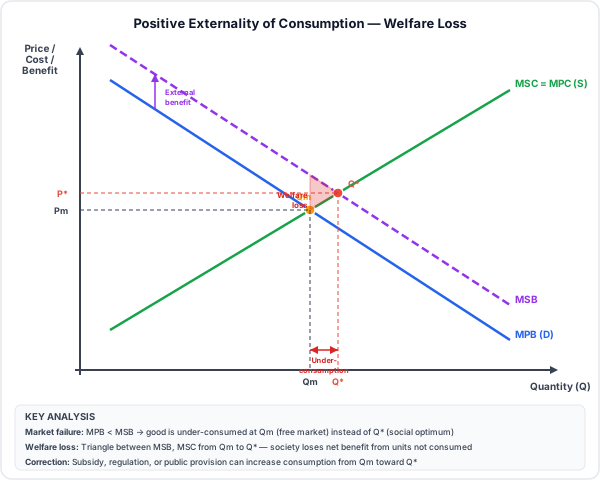
A merit good is one that generates positive externalities or external benefits when consumed. Merit goods are under-consumed at the free market equilibrium because consumers do not fully account for the social benefits of consumption. Classic examples include education, healthcare, and vaccinations. The market failure occurs because the private benefit to the individual consumer is less than the social benefit to society as a whole.
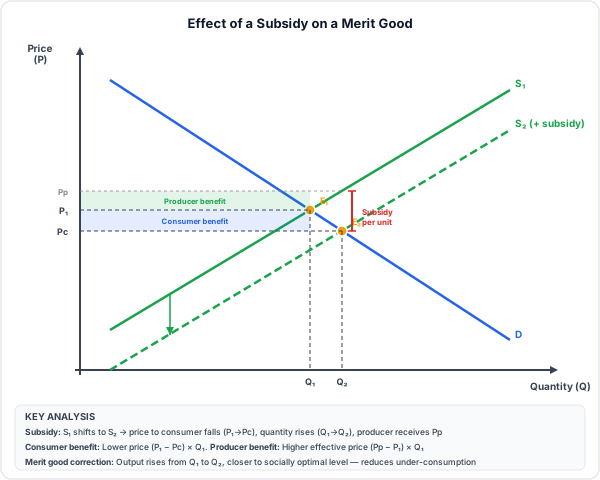
A subsidy works by reducing the price paid by consumers. When a government introduces a per-unit subsidy on a merit good like education, the price to the consumer falls from P1 to P2. This lower price incentivizes more consumption—quantity demanded increases from Q1 to Q2. The subsidy effectively shifts the demand curve rightward or equivalently shifts the supply curve downward, moving the market equilibrium closer to the socially optimal level where marginal social benefit equals marginal social cost.
Consider the example of university education in countries like Germany or Nordic nations. A government subsidy reduces tuition fees, making higher education more affordable. More individuals enroll in university, increasing the overall consumption of education. The social benefits—a more skilled workforce, higher productivity, and reduced crime—become more fully realized as education consumption rises to a level closer to what society would choose.
Diagrammatically, a subsidy appears as a rightward shift of supply or a reduction in the effective price consumers pay. The equilibrium moves from E1 (market) to E2 (post-subsidy), with quantity increasing and price to consumer falling. The government pays the difference between the equilibrium price and the subsidized price, creating a budgetary cost equal to subsidy per unit × quantity consumed. The deadweight loss from under-consumption is reduced, improving allocative efficiency.
PART (B) — EVALUATE THE EFFECTIVENESS OF SUBSIDIES VERSUS LEGISLATION
Both subsidies and legislation can correct the under-consumption of merit goods, but they operate through different mechanisms and carry distinct advantages and disadvantages. Subsidies use price incentives to encourage voluntary consumption, whereas legislation mandates consumption or participation. The relative effectiveness depends on context—the nature of the merit good, the target population, administrative capacity, and cultural factors all influence which approach works better.
Subsidies are effective because they preserve consumer choice and can reach diverse populations through price mechanisms. For example, subsidizing childhood vaccinations through government health programs has dramatically increased immunization rates in developing countries. The lower price removes a financial barrier. However, subsidies require substantial government expenditure—vaccinating an entire population may cost billions over time. Additionally, subsidies may be regressive if not carefully targeted; wealthy individuals benefit as much as poor individuals when prices fall universally.
Legislation, by contrast, enforces participation directly. Mandatory education laws in developed countries have achieved near-universal primary school enrollment, regardless of family income. Legislation does not require ongoing subsidies and guarantees high consumption rates. However, legislation can be politically unpopular and difficult to enforce, especially in societies with weak institutional capacity. Mandatory healthcare may be resisted if citizens lack trust in government institutions, as seen in historical anti-vaccination movements in some European countries.
In practice, the most effective approach often combines both. High-income countries like the UK use compulsory education law combined with free public provision (essentially a 100% subsidy), achieving both high coverage and social equity. The United States uses subsidies for tertiary education (student grants and loans) but stops short of mandatory attendance, reflecting different values around choice. Developing countries with limited budgets often rely on subsidies for targeted populations (e.g., girls' education in India) or on free provision in government schools, which serves as a strong subsidy.
From an economic efficiency perspective, subsidies reduce deadweight loss by moving quantity consumed closer to the socially optimal level. However, subsidies create government expenditure and may generate deadweight loss if funding comes from distortionary taxes. Legislation eliminates choice-based deadweight loss but may create compliance costs and enforcement deadweight loss. A key distinction: subsidies are demand-side interventions (lowering the price facing consumers), while legislation is a quantity-side intervention (directly mandating a minimum consumption level). The choice between them reflects both economic logic and non-economic values such as liberty and social cohesion.
In conclusion, neither subsidies nor legislation is universally superior. Subsidies work better when consumer preferences vary and choice is valued; they are flexible and can be means-tested to improve equity. Legislation is more effective when rapid, uniform consumption change is needed and government capacity is strong. The most successful policies typically blend both approaches: mandatory participation combined with subsidized or free provision, such as in healthcare systems across Scandinavia. The choice depends critically on specific social and economic context.
Question 2: Macroeconomics
SL/HL Unit 3(b) Evaluate the view that fiscal policy is more effective than monetary policy in achieving full employment. [15 marks]
Define unemployment types, show fiscal policy mechanism
Compare policy effectiveness, discuss limitations
PART (A) — EXPLAIN HOW EXPANSIONARY FISCAL POLICY CAN BE USED TO REDUCE DEMAND-DEFICIENT UNEMPLOYMENT
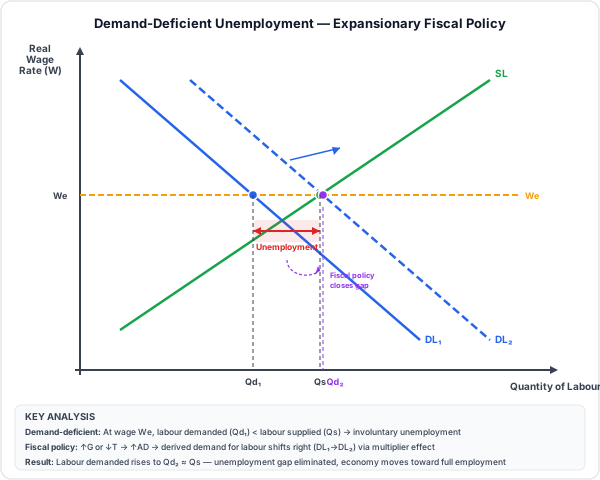
Demand-deficient unemployment, also called cyclical unemployment, occurs when aggregate demand in the economy falls below the level required to provide jobs for all willing workers at the prevailing wage rate. This type of unemployment arises during recessions or periods of low economic growth. Unlike structural or frictional unemployment, demand-deficient unemployment is caused by insufficient demand for labour across the economy rather than skills mismatch or job search processes. It represents a failure of the labour market to clear at full employment.
Expansionary fiscal policy refers to government actions that increase aggregate demand, including increased government spending on infrastructure, education, or healthcare, and/or reduced taxation. These policies inject money into the economy, boosting purchasing power and business confidence. The government essentially uses its spending and taxing powers to stimulate economic activity when private sector demand is weak.
The mechanism operates through the multiplier effect. When the government increases spending—for example, on building new roads—construction firms receive contracts, workers are employed, and those workers spend wages on goods and services, creating demand for more workers in other sectors. A single unit of government spending generates more than one unit of total spending in the economy. If the multiplier is 2, then a 100 billion dollar government spending increase raises aggregate demand by 200 billion dollars, shifting the AD curve rightward in macroeconomic equilibrium.
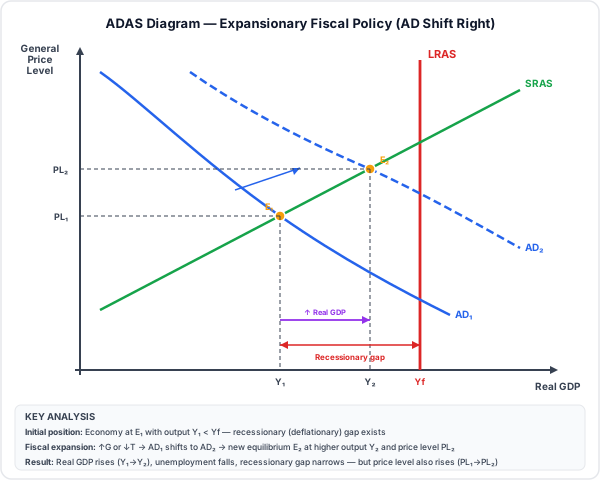
As aggregate demand rises, firms expand production to meet increased consumer and government demand. To produce more output, firms must hire more workers. Unemployment falls from U1 (recession level) to U2 (lower level closer to full employment). Real GDP increases from Y1 to Y2. The economy moves rightward along the short-run aggregate supply curve, with both output and employment increasing. This is particularly effective when there is significant spare capacity in the economy—underutilized factories and unemployed workers can be brought back into production without significant price inflation.
Diagrammatically, expansionary fiscal policy shifts the AD curve rightward from AD1 to AD2. The new equilibrium moves from E1 to E2, with real GDP rising from Y1 to Y2 and unemployment falling. The size of the employment effect depends on the multiplier (determined by marginal propensity to consume and tax rates) and the slope of the SRAS curve. In a deep recession with high spare capacity, the SRAS is relatively flat, so expansionary fiscal policy has large real output and employment effects. The government budget deficit increases—government spending rises relative to tax revenues—adding to public debt in the short term.
PART (B) — EVALUATE THE VIEW THAT FISCAL POLICY IS MORE EFFECTIVE THAN MONETARY POLICY
Both fiscal and monetary policy are tools for managing aggregate demand, but they operate through different channels and have different strengths and weaknesses. Fiscal policy—government spending and taxation—has direct effects on aggregate demand. Monetary policy—central bank manipulation of interest rates and money supply—works through indirect transmission mechanisms. The relative effectiveness in reducing demand-deficient unemployment depends on economic conditions, institutional factors, and time horizons.
A key argument in favour of fiscal policy is its directness. Government spending directly increases aggregate demand—no transmission lag, no dependence on private sector confidence. During the 2008-2009 financial crisis, many governments (US, UK, China) used expansionary fiscal policy because monetary policy had reached the zero lower bound: interest rates were already near zero, limiting monetary policy's further effectiveness. Fiscal stimulus through tax cuts and infrastructure spending bypassed the need to stimulate investment through lower interest rates, instead directly employing people. The US stimulus package in 2009 is credited with preventing deeper economic contraction and job losses.
However, fiscal policy faces significant practical limitations. Implementation lags—the time needed to design, legislate, and execute government spending—can be substantial. A spending program announced in 2024 may not inject money into the economy until 2025 or 2026, by which time the recession may have already ended naturally. Tax cuts take time for households to recognize and incorporate into spending decisions. Additionally, fiscal stimulus increases government borrowing, raising long-term interest rates, which can crowd out private investment. If expansionary fiscal policy drives up interest rates, firms may reduce capital investment, offsetting some of the stimulus effect.
Monetary policy, by contrast, can be implemented rapidly. Central bank interest rate decisions take effect immediately, though the real effects on employment take time—the transmission mechanism operates through changed borrowing costs, asset prices, and business confidence. Monetary policy is more flexible: central banks can adjust rates up and down as conditions change, whereas fiscal policy requires political consensus and legislative action, making reversals difficult. However, monetary policy relies on expectations and confidence. If households and firms expect persistent unemployment, they may not increase spending even when interest rates fall, particularly if there is high uncertainty or balance sheet damage from recession.
The liquidity trap scenario, experienced by Japan in the 1990s and 2000s, demonstrates monetary policy's weakness during severe recessions. With interest rates already at zero and expectations of persistent weak growth, further monetary expansion (quantitative easing) has limited impact on real output and employment. In contrast, fiscal stimulus can still work because it injects demand directly, regardless of interest rates. However, in moderate recessions where confidence is not completely broken, monetary policy can be highly effective and carries no fiscal cost or crowding out risk.
From a macroeconomic theory perspective, the relative effectiveness depends on the slopes of the LM and IS curves. In a liquidity trap (horizontal LM), fiscal policy shifts the IS curve rightward and has large effects on output; monetary policy cannot shift the LM further leftward. In a monetarist world where the LM is steep (money demand insensitive to interest rates), monetary policy is more effective at shifting equilibrium rightward. The effectiveness also depends on the marginal propensity to consume and the sensitivity of investment to interest rates. High MPC strengthens the fiscal multiplier; high investment sensitivity to interest rates strengthens monetary policy transmission.
In conclusion, neither policy is universally superior. Modern consensus suggests both are needed: monetary policy provides the first line of response due to its speed and flexibility; fiscal policy provides support when monetary policy reaches limits, particularly in deep recessions. The most successful economies typically use both together—the 2008-2009 crisis response combined unprecedented monetary expansion with fiscal stimulus. The view that fiscal policy is more effective is partially true in liquidity trap conditions and severe downturns, but overstates the case: monetary policy remains more flexible and can be effective in normal recessions. The choice between them, and their combination, should reflect specific macroeconomic conditions.
Question 3: International Economics
SL/HL Unit 4(b) Evaluate the arguments for and against the use of protectionist measures by developing countries. [15 marks]
Define tariff, show diagram effects on price, quantity, surplus
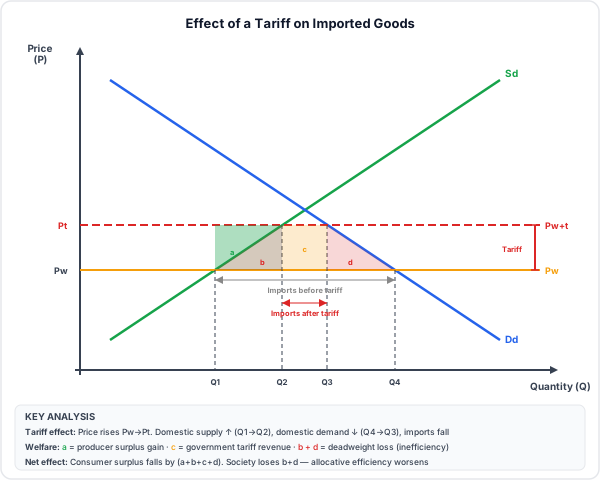
Compare infant industry, employment, revenue arguments vs efficiency losses
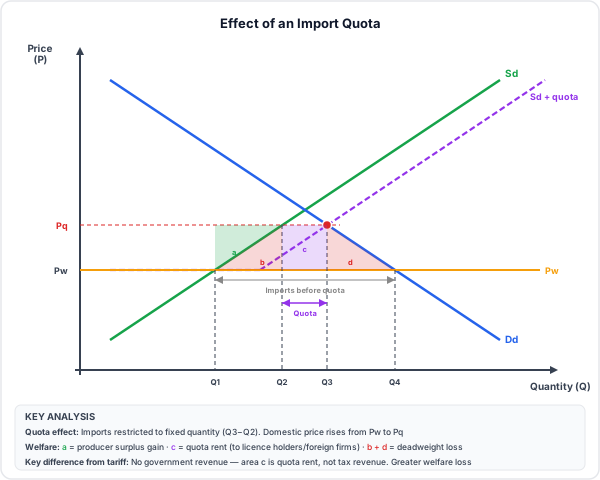
PART (A) — EXPLAIN THE EFFECTS OF IMPOSING A TARIFF ON IMPORTED GOODS USING A DIAGRAM
A tariff is a tax imposed on imported goods, raising their price in the domestic market relative to the world price. Tariffs are a form of trade protection that increases the domestic price of foreign goods, making them less competitive compared to domestically produced substitutes. The tariff rate is expressed either as a specific amount per unit (e.g., $5 per tonne of imported steel) or as an ad valorem rate (e.g., 20% of the import price). Tariffs are commonly used by governments to protect domestic industries from foreign competition.
In a domestic supply and demand diagram, before the tariff, the economy trades at the world price Pw, importing the difference between domestic demand and domestic supply. Quantity demanded is Q1 (on demand curve), domestic supply is Q2, and imports are Q1 minus Q2. After the tariff is imposed, the domestic price rises to Pt (world price plus tariff). At this higher price, domestic quantity demanded falls to Q3 (movement along demand curve), while domestic quantity supplied increases to Q4 (movement along supply curve). Imports fall to Q3 minus Q4—the tariff has reduced import volumes significantly.
The tariff creates multiple effects on economic welfare. Domestic producers benefit—they now sell more output (Q4 instead of Q2) at a higher price (Pt instead of Pw), increasing producer surplus. The area representing this gain is shaded in the diagram. Consumers lose—they pay higher prices and buy less, reducing consumer surplus. The area of consumer loss is larger than the producer gain, representing deadweight loss. The government collects tariff revenue equal to the tariff per unit multiplied by the quantity of imports (Q3 minus Q4). This revenue is shown as the shaded rectangle in the diagram.
Diagrammatically: the demand curve slopes downward; the supply curve slopes upward. The world price line is horizontal at Pw. After the tariff, a horizontal line appears at Pt = Pw + tariff. Equilibrium moves from (Q1, Pw) in the free trade case to (Q3, Pt) for domestic demand and (Q4, Pt) for domestic supply. The deadweight loss appears as two small triangular areas: one above the tariff price line and demand curve (consumer deadweight loss from reduced consumption), and one below the tariff price and supply curve (producer deadweight loss from resources used inefficiently). Total welfare loss equals these triangles minus any government revenue reallocation, but in pure economic terms, tariffs reduce allocative efficiency because marginal benefit no longer equals marginal cost at the margin.
PART (B) — EVALUATE THE ARGUMENTS FOR AND AGAINST PROTECTIONIST MEASURES BY DEVELOPING COUNTRIES
Developing countries face a unique position in global trade: they often lack the capital, technology, and economies of scale that developed countries possess. The question of whether protectionism is justified for developing nations requires careful evaluation of both theoretical arguments and empirical evidence. Different protectionist arguments carry different weight depending on the specific developing country's circumstances.
The infant industry argument is perhaps the strongest case for protectionism in developing countries. The argument states that new industries in developing nations cannot initially compete with established, efficient producers in developed countries due to scale disadvantages and lack of experience. If temporary tariffs protect these "infant industries" during their early growth phase, they can eventually become competitive globally. South Korea's automotive and steel industries benefited from tariff protection in the 1960s-1970s and subsequently became world-class competitors. India's information technology sector benefited from partial protection and government support before becoming globally dominant. The argument is that without temporary protection, infant industries might never develop, locking developing countries into comparative advantage in primary products with low value-added and limited growth potential.
Employment protection is another argument. Manufacturing tariffs can protect jobs in developing countries where unemployment is high and social safety nets are weak. A tariff on imported textiles keeps textile factories operating and workers employed in countries like Bangladesh or Vietnam, where alternative employment may not exist. Government revenues generated by tariffs can fund development spending in education and infrastructure. Tariff revenues are often significant in developing countries with limited tax bases, providing fiscal resources for public investment. Additionally, protectionism can improve the terms of trade if a developing country is a large enough importer to influence world prices—restricting imports raises world prices for those goods, benefiting other developing country producers of those goods.
However, significant counterarguments against protectionism are compelling. Tariffs create deadweight loss by reducing allocative efficiency: resources are allocated to less efficient domestic industries rather than to sectors where the developing country has comparative advantage. This misallocation reduces overall economic growth. Consumers in developing countries pay higher prices, reducing purchasing power and disproportionately harming the poor who spend larger shares of income on basic goods. A tariff on rice or corn in a developing country raises food costs for poor families, potentially causing malnutrition and reducing human capital formation. Empirical evidence suggests that excessively protectionist countries (like India before liberalization in 1991, or many African countries) experienced slower growth than countries that gradually liberalized trade.
Protectionism also invites retaliation, escalating into trade wars that harm developing countries more than developed countries due to their dependence on export markets. When the United States imposed steel tariffs in 2002, retaliation from other countries followed, harming US exporters and trading partners. Similarly, developing countries that impose tariffs risk losing market access in developed countries, reducing export opportunities. Protected industries may become inefficient and lose competitiveness if tariffs persist too long—they may lobby governments to maintain protection indefinitely, creating permanent inefficiencies. South Africa's automotive industry remained uncompetitive for decades despite tariff protection, eventually requiring a major restructuring when tariffs were reduced. This demonstrates the risk of "infant industries" that never grow up.
A nuanced assessment suggests that selective, temporary protectionism for genuine infant industries may be justified, but broad or permanent protectionism is economically damaging. Developing countries like South Korea, Taiwan, and China succeeded by combining temporary protection with export promotion and heavy investment in education and R&D—protection alone was never sufficient. Chile's development was accelerated by gradual tariff reduction combined with investment in human capital and infrastructure. The World Trade Organization (WTO) allows developing countries greater flexibility in trade policy than developed countries, recognizing the legitimate need for some protection during development. However, the evidence suggests the poorest developing countries benefit most from trade openness and global market access, not from protection.
From an economic perspective, protectionism must be evaluated against alternative policies that might achieve development goals more efficiently. Instead of tariffs (which create deadweight loss), developing countries might use infant industry subsidies (which allow free trade pricing while aiding producers), or invest in education and infrastructure (building comparative advantage in high-skill sectors). The concept of dynamic comparative advantage—the idea that comparative advantage changes as countries develop skills and capital—suggests that temporary protection combined with active capability-building may accelerate development. However, the time-inconsistency problem is real: protected industries lobby for indefinite protection, making temporary tariffs politically difficult to remove. This supports the use of tariffs with explicit phase-out schedules, like those in manufacturing agreements in Bangladesh or Vietnam.
In conclusion, protectionism is not inherently wrong for developing countries, but must be carefully limited in scope, duration, and level. The infant industry argument has merit but is often overstated—many industries claiming infant status never mature. Broad consumer goods tariffs harm the poor without generating long-term development benefits. The most successful developing countries (Singapore, South Korea, Botswana) combined strategic, limited protection with open trade policies, strong investments in human capital, and governance improvements. Developing countries would gain more from global trade agreements that allow them market access than from pursuing isolation through tariffs. Regional trade agreements, rather than unilateral protectionism, may offer middle-ground solutions that provide some infant industry support while maintaining competitive pressure.
Question 4: Price Discrimination
SL/HL Unit 2(b) Evaluate whether price discrimination is beneficial or harmful to consumers and society. [15 marks]
Define price discrimination, explain conditions (segmentation, barriers, elasticity)
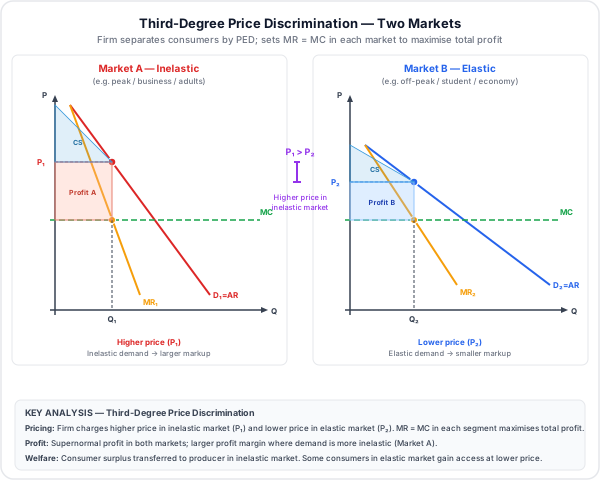
Discuss consumer surplus, allocative efficiency, equity concerns
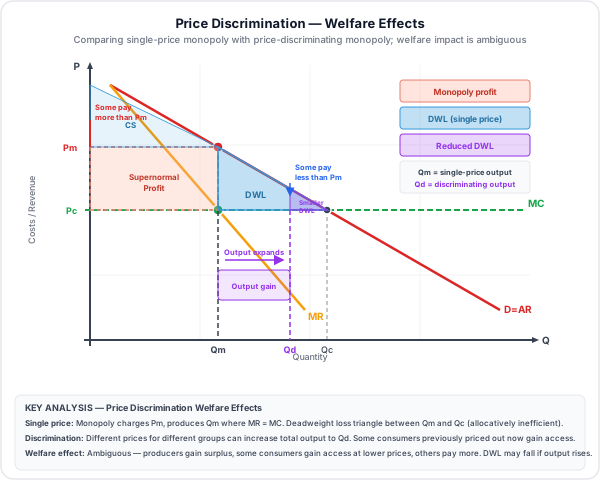
PART (A) — EXPLAIN PRICE DISCRIMINATION
Price discrimination occurs when a firm charges different prices to different groups of customers for the same product, based on their willingness or ability to pay, rather than on differences in production costs. Examples include student discounts at cinemas, business vs. economy class on airlines, and prescription drugs priced differently in rich vs. poor countries. Price discrimination allows firms with market power to extract consumer surplus and increase profit beyond what they could earn with uniform pricing.
Three conditions are necessary for price discrimination to occur: (1) Market power—the firm must be a price maker, not a price taker (monopoly or imperfect competition); (2) Ability to segment markets—the firm must be able to identify and separate customers into groups with different price elasticities; (3) Prevention of arbitrage—there must be barriers preventing customers in low-price segments from reselling to high-price segments, or customers cannot easily switch segments to access lower prices.
In airline pricing, airlines use price discrimination extensively. Business travelers have inelastic demand (they must travel regardless of price for work) while leisure travelers have elastic demand (they will delay travel if prices are high). Airlines segment by offering expensive, flexible business fares and cheap, restrictive economy fares. They prevent arbitrage by restricting when cheap tickets can be used (no weekend travel restrictions for business flights). Pharmaceutical companies use price discrimination by charging high prices in wealthy countries with patent protection while licensing generics in poor countries—market segmentation is geographic, and arbitrage is prevented by intellectual property law and distribution controls.
The price discrimination formula states that firms set MR = MC for each segment and charge prices where MR = MC according to each segment's demand elasticity. High-price segments have inelastic demand (price increases by more than quantity falls), low-price segments have elastic demand (price decreases cause quantity to increase substantially). This explains why students and pensioners get bigger discounts (elastic demand) than prime-age workers (inelastic). First-degree (perfect) discrimination charges each customer their maximum willingness to pay; second-degree uses quantity discounts or bundling; third-degree (most common) charges different prices by observable characteristics like age or region.
PART (B) — EVALUATE PRICE DISCRIMINATION
Price discrimination has ambiguous welfare effects. It can be beneficial when it increases access to goods for price-sensitive customers, but harmful when it exploits vulnerable groups. The net effect on consumer and social welfare depends on the context and magnitude of discrimination.
Benefits of price discrimination: Student discounts enable low-income young people to access education, entertainment, and transport—goods that may have positive externalities. Without discounts, some students might be priced out entirely. Pharmaceutical price discrimination allows cheaper drugs in developing countries, improving health outcomes for billions at minimal cost to pharmaceutical firms (marginal cost of production is very low). Peak/off-peak pricing for utilities encourages off-peak consumption, reducing infrastructure costs and environmental impacts. Online pricing that offers discounts to price-sensitive shoppers increases allocative efficiency.
However, harms include regressivity and exploitation. Elderly people on fixed incomes facing higher healthcare prices due to lower price elasticity suffer a genuine hardship. Credit card companies charge lower-income customers higher interest rates because they have less access to alternative credit, exploiting limited options rather than true preferences. Airline pricing extracts maximum surplus from business travelers who are less sensitive to price due to business necessity, not preference. Poor households may face higher per-unit prices for basic goods when buying small quantities (no bulk discount), making prices regressive. This violates horizontal equity—people with similar income and preferences are charged differently based on perceived ability to pay.
From an allocative efficiency standpoint, some price discrimination improves efficiency. Allowing a firm to engage in third-degree price discrimination can increase output compared to uniform monopoly pricing—more customers access the product at lower prices, reducing deadweight loss. However, the profit generated allows the monopoly to persist and may discourage competitive entry. Perfect price discrimination, while theoretically maximizing total output, transfers all consumer surplus to the producer, eliminating consumer welfare gains. The firm produces at allocatively efficient quantity (where P = MC), but all benefit goes to the firm.
The welfare analysis requires distinguishing between allocative efficiency and equity. Price discrimination may increase allocative efficiency (output closer to socially optimal level) while reducing equity (distribution of surplus becomes more unequal). Regulation must balance these. Banning price discrimination (uniform pricing) guarantees equity but may reduce output—some price-sensitive customers are priced out. Allowing regulated price discrimination (e.g., mandated student discounts, tiered utility pricing) can improve both efficiency and equity. Perfect price discrimination is allocatively efficient but inequitable; it should be restricted when it harms vulnerable groups (elderly, poor) but allowed when it improves access (students, off-peak users).
Conclusion: Price discrimination is not inherently good or bad. In sectors like education, healthcare, and transport, controlled discrimination (by age, income, time-of-use) can improve both efficiency and access. In financial services and luxury markets, discrimination often exploits customers lacking alternatives and should be restricted. Policy should focus on preventing discrimination based on immutable characteristics (race, ethnicity) and ensuring vulnerable groups are protected, while allowing discrimination that expands access and reduces deadweight loss. The UK's regulation of rail pricing (off-peak discounts, pensioner discounts) exemplifies reasonable discrimination; predatory lending with price discrimination based on financial desperation exemplifies harmful discrimination.
Question 5: Price and Income Elasticity of Demand
SL/HL Unit 1(b) Evaluate the view that understanding elasticity of demand is essential for government policymakers. [15 marks]
Define elasticity, explain determinants, use income and substitution effects
Discuss policy applications: taxation, subsidies, public health
PART (A) — EXPLAIN PRICE ELASTIC VS INELASTIC DEMAND
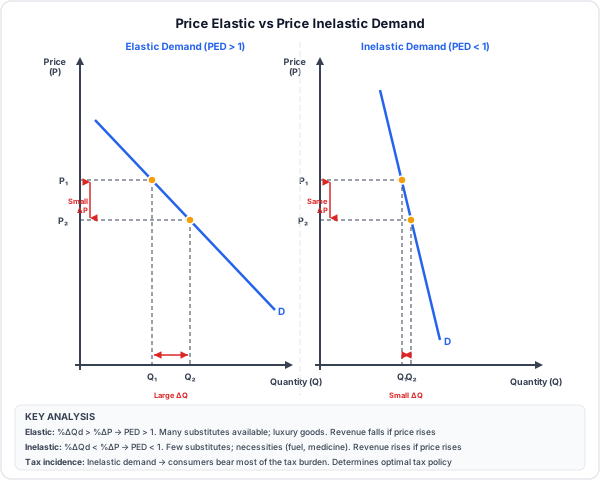
Price elasticity of demand (PED) measures the responsiveness of quantity demanded to changes in price. If PED > 1, demand is price elastic—the percentage change in quantity demanded exceeds the percentage change in price. If PED < 1, demand is price inelastic—quantity demanded changes by a smaller percentage than price changes. For example, if a 10% increase in price causes a 15% fall in quantity demanded, PED = -1.5 (elastic). If a 10% price increase causes only a 2% fall in quantity, PED = -0.2 (inelastic).
The income and substitution effects explain why elasticity varies across goods. The substitution effect occurs when relative prices change—as a good becomes more expensive, consumers switch to cheaper alternatives. The income effect occurs because a price increase reduces real income (purchasing power), affecting consumption of all normal goods. For inferior goods (e.g., cheap processed food), the income effect may increase quantity demanded when price falls (paradoxical), partially offsetting the substitution effect.
For goods with many substitutes, the substitution effect is strong—when the price of one brand of coffee rises, consumers switch to other brands, making demand elastic. When a good has few substitutes (gasoline, insulin), the substitution effect is weak and demand is inelastic—consumers must keep driving or taking medication despite price increases. Essential goods have inelastic demand because reducing consumption is difficult. Income effects matter more for expensive items (housing, cars) that consume large budget shares—a 10% rise in housing costs meaningfully reduces real income and affects consumption of many goods. For cheap items (salt, pencils), the income effect is negligible.
For normal goods, substitution and income effects work in the same direction—when price falls, both effects increase quantity demanded, creating a downward-sloping demand curve. For inferior goods like instant noodles (consumed when real income is low), the income effect could theoretically outweigh the substitution effect, creating an upward-sloping demand curve (Giffen good). Historically, cheap bread and potatoes in poor regions exhibited Giffen properties: when prices fell, real incomes of the poorest rose enough that they switched to higher-quality foods, reducing bread consumption. This is rare in modern economies with diverse options and less absolute poverty.
Mathematically, the total effect of a price change = substitution effect (always negative for normal goods) + income effect (negative for normal goods, positive for inferior goods). For elastic goods, substitution effects dominate—consumers have many alternatives and adjust significantly. For inelastic goods, both effects are small relative to baseline consumption. The degree of elasticity depends on the share of the good in total expenditure, availability of substitutes, and whether the good is a necessity or luxury—beer has higher PED than salt, concert tickets have higher PED than electricity, foreign holidays have higher PED than domestic transport.
PART (B) — EVALUATE IMPORTANCE OF ELASTICITY FOR POLICYMAKERS
Understanding elasticity is often essential for policymakers, though its importance varies by policy goal. Elasticity estimates determine tax incidence, subsidy costs, effectiveness of health regulations, and distributional impacts of policy. However, elasticity is one of many factors affecting policy success—political feasibility, equity, and implementation capacity also matter.
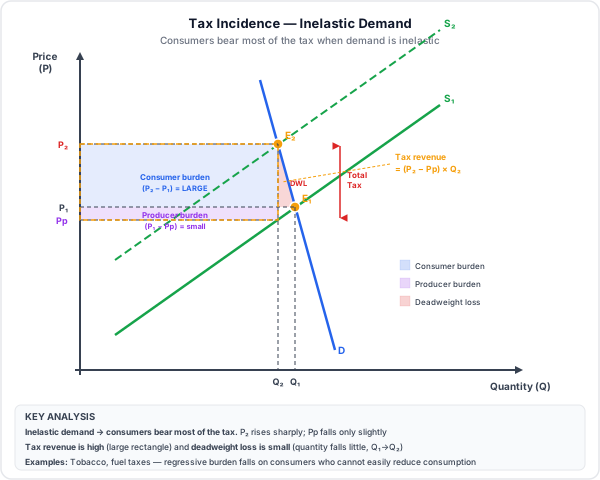
For taxation, elasticity determines incidence and deadweight loss. A tax on inelastic goods (fuel, cigarettes) generates high revenue with low quantity reduction—most of the tax falls on consumers. A tax on elastic goods (luxury items) generates less revenue and creates large deadweight loss as consumers switch to untaxed alternatives. Policymakers must understand these elasticities to design equitable tax systems. A 10% fuel tax with PED = -0.3 increases fuel prices by about 7% to consumers (with deadweight loss), but a 10% wine tax with PED = -1.2 causes significant substitution to beer, generating deadweight loss and lower revenue. This knowledge helps governments choose which goods to tax.
For health policy, elasticity is critical. If demand for cigarettes is inelastic (PED ≈ -0.4), raising cigarette taxes reduces smoking less than expected—primarily regressive, harming low-income smokers. If long-run elasticity is more elastic (PED ≈ -0.8), taxes are more effective at reducing smoking, especially among youth. Similarly, subsidies for healthy foods (vegetables) only work if demand is elastic—if vegetables are inelastic, subsidies waste money and provide little behavior change. Public health officials who understand elasticity can design policies that actually change behavior, not just redistribute income.
However, elasticity knowledge is insufficient alone. A government may understand that cigarette demand is inelastic but still implement high cigarette taxes for equity or health reasons, accepting that few smokers quit. Subsidizing public transport might increase ridership (elastic) but fail if transit infrastructure can't handle the demand or if other barriers (distance, frequency) prevent usage. A carbon tax on gasoline addresses climate change even if demand is inelastic—the policy goal is to reduce emissions, not necessarily tax revenue. Policymakers must integrate elasticity knowledge with distributional goals, environmental externalities, and social values.
Elasticity estimates are also subject to uncertainty and may change over time. Cigarette elasticity estimates vary from -0.3 to -1.5 depending on time period, country, and demographic group. Long-run elasticity is typically higher than short-run (it takes time to quit smoking or switch to fuel-efficient cars), so the same policy has different effects after 5 vs. 15 years. Poor elasticity estimates lead to policy failures—the UK's 2008 fuel duty escalator assumed relatively inelastic demand, but elastic demand responses caused government revenue shortfalls and policy reversal. Good policymaking requires combining elasticity knowledge with adaptive policy mechanisms that adjust as conditions and responses change.
In formal terms, understanding elasticity is necessary but not sufficient for policy success. Elasticity determines the partial effect of price changes on quantity consumed. The total policy effect also depends on the transmission mechanism (how policy changes prices), behavioral responses (do people respond as predicted), and distributional consequences (who bears the tax burden). High-quality policymaking requires measuring elasticity accurately, understanding confidence intervals around estimates, predicting how elasticity may change with different policy designs, and communicating uncertainty to stakeholders. Advanced policymakers combine econometric elasticity estimates with behavioral research, pilot programs, and adaptive implementation to improve effectiveness.
Conclusion: Understanding elasticity is genuinely essential for evidence-based policymaking, but must be combined with broader social, political, and ethical considerations. For revenue-focused taxes, elasticity determines efficiency—understanding elasticity prevents wasted effort. For behavior-change policies (health, environment), elasticity is central to policy design—low elasticity requires stronger interventions like regulation instead of taxation. For distributional policies, elasticity knowledge reveals incidence and helps policymakers understand whether taxes are progressive or regressive. Without elasticity knowledge, governments risk designing policies that fail to achieve objectives or have unintended consequences. Modern policymaking integrates elasticity research with real-world testing and adaptive governance.
Question 6: Exchange Rate Determination
SL/HL Unit 4(b) Evaluate whether a depreciating currency is always beneficial for economic growth. [15 marks]
Link inflation to exchange rates via purchasing power parity and competitiveness
Discuss benefits (export competitiveness) and drawbacks (import costs, inflation)
PART (A) — EXPLAIN INFLATION'S EFFECT ON EXCHANGE RATE AND COMPETITIVENESS
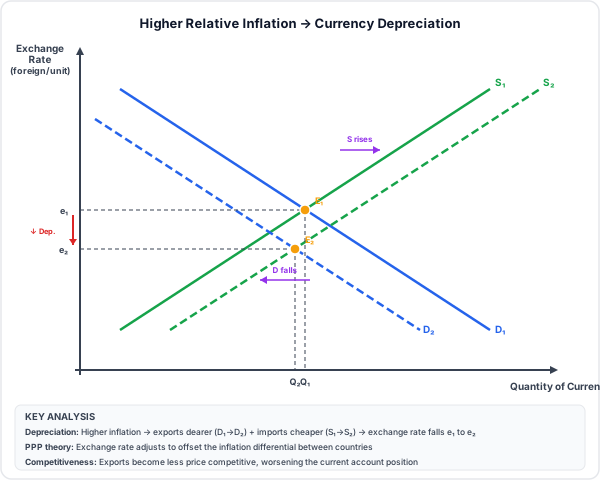
Purchasing Power Parity (PPP) suggests that exchange rates adjust to equalize the purchasing power of different currencies. If Country A has 5% inflation while Country B has 2% inflation, goods in Country A become more expensive relative to Country B. Consumers and businesses prefer cheaper goods from Country B, increasing demand for Country B's currency and reducing demand for Country A's currency. This excess supply of Country A's currency relative to demand causes the exchange rate to depreciate—Country A's currency becomes weaker.
International competitiveness refers to the ability of a country's firms to compete in global markets. Competitiveness depends on both price (determined by production costs and exchange rates) and non-price factors (quality, innovation, brand). Higher inflation in Country A makes its exports more expensive in foreign currency terms, reducing price competitiveness. For example, if Italian inflation exceeds German inflation, Italian wine and fashion become more expensive for foreign buyers, reducing export sales unless quality premiums offset higher prices.
The mechanism works through purchasing power. Suppose an Italian wine costs €20 when the Euro/Dollar rate is 1:1. If Italy experiences 5% inflation and the US experiences 0% inflation, the wine now costs €21, which is still $21. However, if the exchange rate remains fixed, the wine is now more expensive to American buyers. In a floating exchange rate system, the Euro depreciates to restore PPP. If the Euro depreciates to 0.95:1 (€1 = $0.95), the €21 wine costs $20 again—competitiveness is restored. This automatic adjustment is the benefit of floating rates: they prevent persistent loss of competitiveness from inflation differentials.
In real historical terms, the UK's entry into the Exchange Rate Mechanism in 1990 at an overvalued parity combined with UK inflation remaining above German inflation led to loss of competitiveness, forcing exit in 1992. The subsequent pound depreciation (from DM2.95 to DM2.40 per pound) restored competitiveness, helping export-led recovery in the 1990s. Similarly, Brazilian inflation in excess of world inflation caused the Real to depreciate by 40% from 1999 to 2003, making Brazilian exports (coffee, steel, agricultural products) more competitive globally despite higher production costs.
Formally, the relationship is: % change in exchange rate ≈ inflation rate differential. If Country A's inflation is 5 percentage points higher than Country B's, Country A's currency depreciates by approximately 5% in nominal terms. Real exchange rates (adjusted for inflation) remain more stable under PPP, though short-term deviations persist due to capital flows and non-tradable goods. Non-price competitiveness (brand strength, technology, quality) can allow countries to maintain export markets despite depreciation, as seen with Swiss and German exporters maintaining high-value sales despite strong currencies. However, large inflation differentials eventually erode even quality-based competitiveness as higher costs accumulate.
PART (B) — EVALUATE WHETHER DEPRECIATION BENEFITS GROWTH
Currency depreciation has ambiguous effects on economic growth. It can boost growth through increased export competitiveness but may harm growth through rising import costs and inflation. The net effect depends on the country's economic structure, the reason for depreciation, and inflation expectations.
Benefits of depreciation for growth: Cheaper exports increase demand for domestic goods, expanding export-oriented sectors. After the 2008 global financial crisis, sterling's depreciation (from $2.00 to $1.40) supported UK manufacturing recovery by making goods more competitive. Asian economies benefited from their depreciating currencies during the 1990s financial crisis, as depreciation made their exports highly competitive—South Korea, Indonesia, and Thailand saw export-led recoveries. Depreciation can also encourage domestic substitution for imports: as imports become more expensive, domestic firms capture market share (import substitution industrialization). For debt-burdened countries with foreign currency debt, depreciation increases the real burden of debt repayment, but can improve trade balances and increase tax revenue through exports, potentially easing debt sustainability.
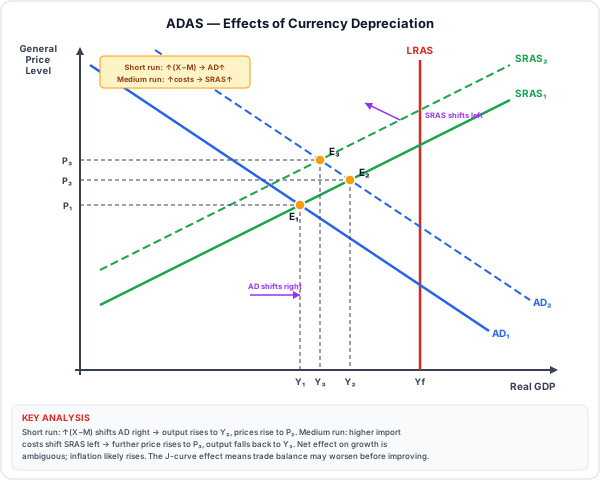
However, depreciation also has harmful effects. Imports become more expensive, raising costs for firms importing inputs and materials—this is particularly damaging for developing countries that import capital goods and fuel. Sri Lanka's currency depreciation in 2022 made energy imports much more expensive, requiring fuel rationing despite growth opportunities in exports. Depreciation increases inflation if economies import significant quantities—food and fuel price increases reduce real incomes and consumption, offsetting export gains. If depreciation was caused by inflation rather than improving competitiveness, it may not stimulate export growth. A depreciating currency can also signal economic crisis (like Turkish Lira or Argentine Peso depreciations), causing capital flight and financial instability that harms growth more than export gains help.
Context determines whether depreciation helps growth. Export-dependent economies (China, Germany, Vietnam) benefit substantially from depreciation, as cheaper exports drive growth. Import-dependent economies (many small islands, landlocked developing countries) suffer more from import cost inflation than they gain from export growth. Economies with large foreign currency debts (Turkey, Ukraine) face particularly adverse effects from depreciation, as debt servicing costs rise in local currency terms. Commodity-exporting economies benefit if depreciation is not offset by commodity price declines, but commodity exporters' currencies often depreciate when commodity prices fall, compounding their difficulties.
The J-curve describes the time pattern of depreciation effects: initially, the current account worsens (existing contracts lock in prices) for 6-12 months, then gradually improves as new contracts reflect lower prices. Depreciation is more likely to increase growth if it reflects underlying productivity improvements (real depreciation) rather than just inflation (nominal depreciation). Policy-induced depreciation through competitive devaluation (deliberately weakening the currency) may spark trade conflicts—the 1930s currency wars resulted from competitive devaluations and worsened global recession. Sustainable growth from depreciation requires complementary policies: investing in export-oriented industries, training workers for export jobs, and maintaining stable macroeconomic policy so depreciation doesn't accelerate into hyperinflation.
Conclusion: Depreciation is not automatically beneficial for growth. It helps growth most when depreciation reflects improved competitiveness and when the economy is export-oriented with spare capacity to expand exports. It harms growth when depreciation results from inflation or financial instability, when the economy relies on imports, or when there are limits to export growth (limited demand, capacity constraints). The most successful emerging market recoveries (South Korea, Vietnam, China) combined currency competitiveness with investment in education, infrastructure, and technology, not relying on depreciation alone. Policy should focus on sustainable improvements in productivity and competitiveness, using exchange rates as one tool among many to support growth.
Question 7: Natural Monopoly and Regulation
SL/HL Unit 2(b) Evaluate the effectiveness of different regulatory approaches to control natural monopolies. [15 marks]
Define natural monopoly, explain economies of scale, discuss market failure
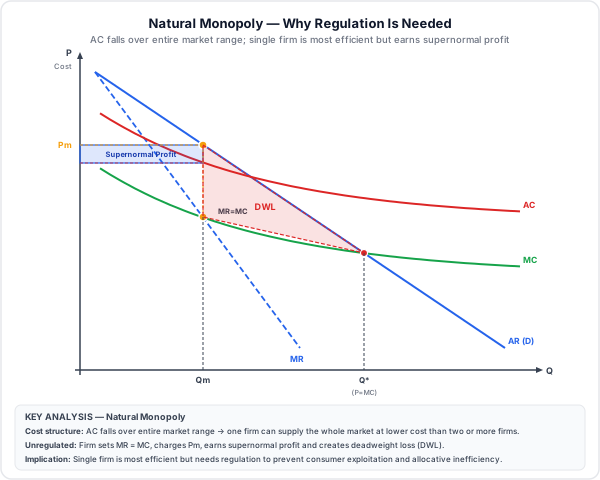
Compare: price capping, average cost pricing, competition, ownership models
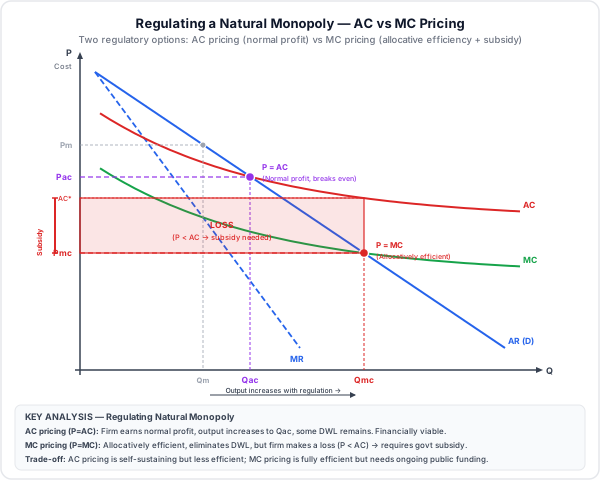
PART (A) — EXPLAIN NATURAL MONOPOLY AND REGULATION
A natural monopoly exists when a single firm can serve the entire market at lower average cost than multiple competing firms. This occurs when there are very high fixed costs and low marginal costs—economies of scale are so significant that one large firm is more efficient than many small competitors. The average cost curve continuously falls as output expands, meaning one supplier serving the whole market operates at minimum cost. Examples include water distribution networks, electricity transmission, and railway networks, where laying pipes, cables, or tracks requires enormous upfront investment but serving additional customers costs little.
Market failure occurs in natural monopolies because competitive entry is impossible—a second firm cannot profitably duplicate the infrastructure, making the market a natural monopoly. If the monopolist operates unregulated, it restricts output and charges monopoly prices (where MR = MC), earning supernormal profit and creating deadweight loss. Natural monopolies left unregulated are more harmful than other monopolies because the barriers to entry are technological, not just economic—no firm can compete regardless of profits.
Water utilities exemplify this. Building duplicate water pipes to each household would be enormously wasteful—it's more efficient to have one network serving everyone. A private unregulated water monopoly could charge customers far above cost, knowing customers cannot avoid the service. In the UK, water companies are regulated to prevent excessive pricing. Indian railway networks, while massive, are natural monopolies—competitors cannot profitably duplicate the rail infrastructure. But because trains serve a public good, governments regulate fares to balance financial viability with affordable access, especially for poor passengers.
Mathematically, a natural monopoly exists when the average cost curve slopes downward over the entire range of market demand. Unlike normal monopolies where firms eventually face rising costs, natural monopolies have economies of scale across all output levels. If P < AC (price below average cost), the firm incurs losses. If P = AC (price equals average cost), the firm breaks even but earns only normal profit—not enough to fund reinvestment in network maintenance and expansion. Regulation must allow sufficient pricing to cover costs while preventing monopoly exploitation. This explains why unregulated and under-regulated utilities often fail to invest adequately (blackouts, water shortage during droughts).
PART (B) — EVALUATE REGULATORY APPROACHES
Various regulatory approaches exist, each with strengths and weaknesses in achieving efficiency and equity. No single approach is universally optimal—context determines which works best.
Price capping (RPI-X regulation in the UK) sets a ceiling on price increases equal to inflation minus an efficiency factor (X). This incentivizes cost reduction—if firms reduce costs more than X, they keep the savings as profit until the next review. This encourages innovation and operational efficiency. However, underinvestment can result if X is set too high, as firms lack incentive to invest when returns are limited. South African electricity utility Eskom underinvested for years due to price caps, leading to severe power shortages by 2022. Another weakness is gaming—firms may hide costs or reclassify expenditures to appear more efficient. The regulator must have strong technical expertise to audit company claims, which is expensive and difficult in developing countries.
Average cost pricing (P = AC) ensures efficiency—consumers pay the full cost of provision. It provides adequate revenue for maintenance and modest investment. However, it provides no incentive for cost reduction since higher costs automatically translate to higher prices. Firms become complacent, accepting inefficiencies knowing they'll be covered. This approach works best when the regulator can easily observe true costs, but in practice, firms have information advantages—they know their own costs better than regulators. AC pricing also doesn't distinguish between justified cost increases (necessary investment) and unjustified ones (managerial excess). Japan's water utilities use cost-based pricing, resulting in reliable service but also complaints about high prices and limited efficiency improvement.
Marginal cost pricing (P = MC) is allocatively efficient—resources are allocated optimally and deadweight loss is eliminated. However, with natural monopolies, MC is often less than AC (because of high fixed costs), so P = MC pricing causes losses. The firm cannot cover fixed costs and will exit unless subsidized. This requires government grants, funded by taxation, which creates deadweight loss in taxation. Some countries use MC pricing for essential services like healthcare or primary education but require taxpayer subsidies. While socially beneficial, subsidies are expensive and politically difficult to maintain long-term.
Competitive tendering (franchising) addresses the problem by creating competition for the market rather than in the market. A government periodically invites bids from firms to operate the utility for a fixed term (5-10 years) at a price approved by tender. The winning firm must commit to service standards and prices; the next tender allows the government to change operators if performance is poor. This leverages competition to reduce prices and improve efficiency. However, tendering is complex and expensive—it requires the government to write detailed contracts, run competitive processes, and monitor operator performance. In developing countries with weak institutions, this often fails—winning firms reduce quality to cut costs (poor electricity reliability), avoid necessary investment (water pipe failures), or provide poor service to low-income areas (not profitable). The UK electricity and water industries were regulated by price capping rather than franchising, as franchising was deemed too complex.
Public ownership (state operation) is another model. Government-owned utilities can prioritize universal access and affordability without profit constraints—Nordic water systems are publicly owned and provide excellent service at reasonable prices. However, public ownership can lead to political interference (ministers setting prices for election purposes), overstaffing, and poor financial discipline. Many developing country utilities are publicly owned but underinvested and inefficient because governments prioritize other expenditure and don't enforce accountability. Venezuelan state oil company PDVSA exemplifies this—once highly efficient, political interference and underinvestment devastated it.
The regulatory problem is fundamentally one of asymmetric information: the firm knows more about its true costs and opportunities than the regulator. All regulation attempts to work around this constraint. Price capping incentivizes efficiency but risks underinvestment. Cost-plus regulation provides investment incentives but removes efficiency incentives. Competition (tendering or multiple operators) reduces information asymmetry through revealed preference (competition shows what's truly achievable) but is infeasible for natural monopolies with single networks. The optimal approach combines elements: price capping to incentivize efficiency, regular reviews (every 5 years) to adjust for genuine cost changes, mandatory investment standards to prevent underinvestment, and service quality requirements to prevent cost-cutting at consumer expense.
Conclusion: No single regulatory approach is universally superior. Price capping works best where regulatory capacity is moderate and firms are sophisticated—the UK model suits developed economies. Cost-plus pricing suits sectors where efficiency comes from network effects rather than operational excellence (water). Competition/tendering works where government capacity is strong and operators' activities are observable. Public ownership suits where universal access and affordability are paramount and government can provide professional management. The most successful natural monopoly systems worldwide combine: clear regulatory authority independent of political interference, multi-year price reviews that incentivize efficiency while allowing cost recovery, explicit investment mandates, service quality standards with penalties, and transparency (publicly available information on costs and performance). Developing countries struggle with regulation because weak institutions make all approaches imperfect; in these contexts, public ownership with professional management may be preferable to weak private regulation.
Question 8: Trade and Development
HL Unit 5(b) Evaluate the view that developing countries benefit more from regional trade agreements than from participation in the World Trade Organization. [15 marks]
Explain comparative advantage, technology spillovers, foreign investment
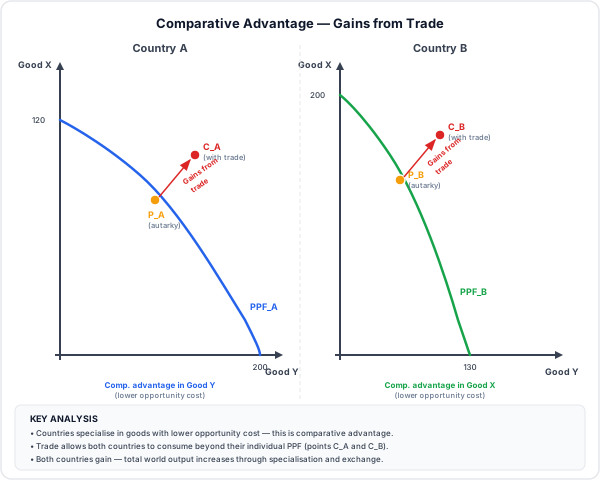
Compare regional agreements (flexibility, political feasibility) vs WTO (global rules, stability)
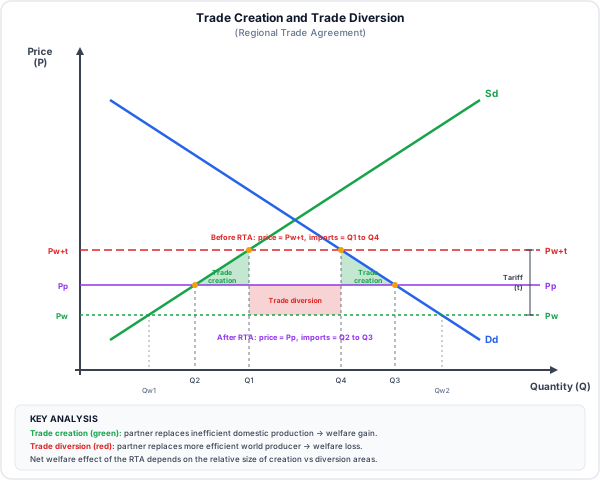
PART (A) — EXPLAIN HOW TRADE CONTRIBUTES TO DEVELOPMENT
International trade allows developing countries to exploit their comparative advantage—the ability to produce goods at lower opportunity cost than other countries. Trade increases the range of goods available to consumers, enables specialization in sectors where countries have advantage, and integrates developing countries into global supply chains that provide employment and foreign exchange earnings. Rather than attempting complete self-sufficiency (autarky), trade allows developing countries to focus on sectors where they excel and import goods where other countries are more efficient.
Vietnam initially had comparative advantage in labor-intensive agricultural products (rice, coffee). Trade allowed Vietnamese farmers to export rice and coffee to global markets at higher prices than domestic consumption alone would generate, increasing rural incomes. Over time, trade exposure led to investment in other sectors—Vietnam developed export-oriented manufacturing (textiles, footwear, electronics) as skills and capital accumulated. Bangladesh followed similar trajectory with garment exports becoming the second-largest export sector. Comparative advantage is not fixed—it evolves as countries accumulate capital and human capital, and trade is the mechanism through which developing countries can realize returns on these investments in global markets.
Trade spurs development through multiple channels: (1) Technology transfer—foreign firms bring advanced technology when investing in developing countries, which local workers and suppliers learn; (2) Foreign Direct Investment (FDI)—developing countries attract investment from global firms seeking to exploit low wages, benefiting from capital inflows; (3) Learning-by-exporting—firms exporting to developed countries learn quality standards and productivity practices that improve efficiency; (4) Integration into supply chains—developing countries become part of global production networks, securing reliable income; (5) Market access—exports to large developed country markets provide growth opportunities larger than domestic markets.
Empirical examples abound. China's opening to trade in 1978 and integration into global supply chains transformed it from low-income to middle-income in two decades—manufacturing exports drove growth and employment. India's IT services exports (Infosys, TCS, Accenture) created a globally competitive sector that generates high-value jobs and skills development, now employing over 5 million people. Rwanda's recent development has been supported by integrating into East African trade (coffee exports, regional supply chains). Countries that opened to trade generally grew faster than those that remained protectionist—empirical research by Sachs, Warner, and others shows trade-open countries had 2-3% faster growth than trade-closed countries in the 1990s. South Korea and Taiwan, which were heavily trade-dependent, grew much faster than India and Mexico, which were more protectionist until the 1990s.
Formally, opening to trade shifts the production possibility frontier—countries can access more goods through trade than through domestic production alone. Developing countries can import capital goods (machinery, technology) that would be unaffordable if produced domestically, accelerating capital accumulation. Comparative advantage theory predicts that trade increases welfare—producers in export sectors benefit from higher prices, workers gain employment, and consumers benefit from cheaper imports. The dynamic gains from trade (learning, accumulation, technological progress) typically exceed static gains. However, distributional issues arise—workers in non-competitive sectors face unemployment and lower wages; adjustments can be painful without social support.
PART (B) — EVALUATE REGIONAL VS WTO TRADE AGREEMENTS
Both regional trade agreements (RTAs) and WTO participation offer benefits for developing country development, but with different characteristics. RTAs (like ASEAN, SADC, MERCOSUR) involve fewer countries and allow tailored rules; WTO membership provides global market access and rule-based dispute resolution. The optimal strategy may combine both.
Regional trade agreements offer advantages: (1) Negotiating power—smaller, developing countries have more influence in regional agreements than in global WTO; (2) Flexibility—rules can be tailored to member countries' development levels, allowing transition periods and special provisions for least-developed members; (3) Trade creation—removing tariffs among neighbors increases bilateral trade more rapidly than global agreements; (4) Deeper integration—RTAs often include labor standards, environmental cooperation, and institutional development that help members converge. ASEAN's integration has been remarkably successful at reducing intra-regional trade barriers while allowing countries flexibility in implementation. SADC (Southern African Development Community) provides a preferential trading environment for neighboring countries that face common development challenges.
However, RTAs have limitations: (1) Limited market size—trade among developing countries is smaller than trade with developed countries, so RTAs provide less growth stimulus than global access; (2) Weak enforcement—regional bodies often lack capacity to enforce agreements; (3) Trade diversion—removing internal tariffs while maintaining external tariffs may shift trade away from more efficient global suppliers to less efficient regional producers, reducing overall welfare; (4) Incomplete agreements—countries often exclude sensitive sectors (agriculture), undermining benefits. MERCOSUR, despite decades of integration, remains fragmented with countries using exceptions and informal protectionism.
WTO membership provides: (1) Most-Favored-Nation (MFN) status—any trade concession granted to one member automatically applies to all, preventing discrimination; (2) Predictability—WTO rules are stable and rule-based, reducing uncertainty for foreign investors and exporters; (3) Dispute resolution—WTO Dispute Settlement Body provides neutral arbitration when countries disagree, protecting small countries from large country bullying; (4) Accession benefits—WTO membership requires policy reforms that improve institutional quality and governance. China's accession to WTO in 2001 required rule-of-law reforms and transparency improvements that benefited development. Least-developed countries receive special treatment in WTO—longer transition periods and preferential market access.
However, WTO membership also involves constraints: (1) Reciprocal tariff reductions—developing countries must lower tariffs on developed country exports, eliminating traditional infant industry protection; (2) Limited flexibility—WTO rules are uniform and difficult to change, offering less adaptation to development needs; (3) Developed country dominance—WTO decision-making reflects developed country interests; past negotiations favored developed countries on agriculture and intellectual property; (4) Limited safety nets—WTO provides less explicit development support than some RTAs. Developing countries have complained that WTO rules on intellectual property prevent access to generic medicines, harming health outcomes.
Empirically, the most successful developing countries combine both. Vietnam, South Korea, and China participate actively in WTO for market access and rules-based stability, while also using regional trade agreements (ASEAN, RCEP) for preferential partner relationships. Vietnam's membership in ASEAN Free Trade Area and CPTPP (Trans-Pacific Partnership) provides access to multiple large markets while WTO membership guarantees access to all markets without discrimination. India has participated in WTO while also building regional relationships through SAARC and BIMSTEC, though with less success due to political tensions.
Economically, RTAs involve trade creation (increase trade among members) and trade diversion (shift trade from efficient external producers to less efficient internal producers). The net effect depends on the degree of overlap—if RTA members already produced similar goods, trade creation dominates; if they produced complementary goods, trade diversion is more problematic. WTO provides non-discriminatory access but requires reciprocal liberalization, which can force developing countries to open sectors where they're not competitive, creating adjustment costs that RTAs might allow longer transition periods to manage.
Conclusion: Developing countries benefit from both RTAs and WTO membership, with complementary roles. RTAs suit regional integration, allow development-sensitive rules, and provide negotiating power. WTO membership provides global market access, rule-based stability, and protects against discrimination. The optimal strategy integrates both: join WTO for predictable, non-discriminatory access to global markets; participate in RTAs tailored to regional development partnerships and needs. Countries that have pursued this strategy (Vietnam, South Korea) have grown faster than those relying only on RTAs (MERCOSUR) or those outside both (North Korea, until recently Myanmar). The most important factor is actually implementation—effective trade policies require institutional capacity, investment in education and infrastructure, and complementary macroeconomic stability. Trade agreements alone, without these fundamentals, benefit countries less than expected.
Question 9: Comparative Analysis of Market Structures
SL/HL Unit 2(b) Evaluate the view that monopolistic competition leads to excessive product differentiation and wasteful advertising. [15 marks]
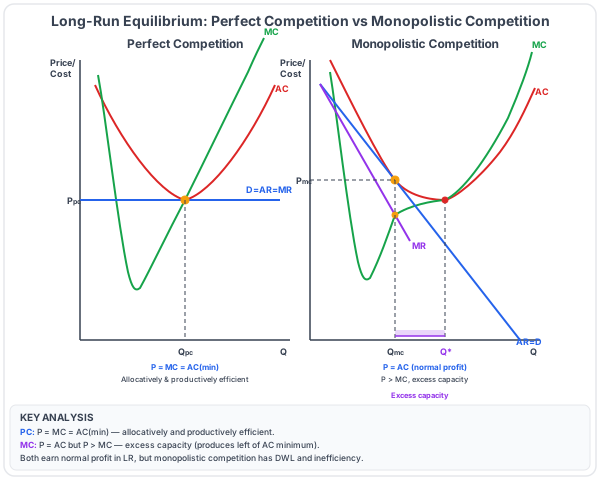
Explain how P > MC in monopolistic competition vs P = MC in perfect competition
Discuss benefits (consumer choice, innovation) and costs (inefficiency, waste)
PART (A) — COMPARE PERFECT COMPETITION AND MONOPOLISTIC COMPETITION
In perfect competition, firms are price-takers producing homogeneous products. Long-run equilibrium occurs where P = AR = AC = MC. Firms earn only normal profit. In monopolistic competition, firms have some market power due to product differentiation. In long-run equilibrium, price exceeds MC (P > MC), meaning firms earn supernormal profit in the short run, but entry erodes this to normal profit long-run as new differentiated competitors arrive. However, even in long-run equilibrium, P > MC due to differentiation.
The key difference: in perfect competition, firms' demand curves are horizontal (perfectly elastic)—any price above the market price loses all customers. Firms cannot raise price above MC in the long run without losing business. In monopolistic competition, firms face downward-sloping demand curves due to brand loyalty and product differences. Starbucks can charge more than a generic coffee shop because customers value the Starbucks brand, environment, and consistency. This downward-sloping demand means firms can charge above MC in long-run equilibrium. Even after entry reduces profit, the differentiated firm maintains some market power.
Real-world examples: wheat farmers (perfect competition) cannot raise prices because buyers view wheat as homogeneous and will buy from cheaper competitors. A wheat farmer selling at $10/bushel when market price is $8 loses all customers. Contrast with differentiated markets: soft drink firms charge premium prices even when generic colas cost less—Coca-Cola succeeds through brand investment and differentiation. The pricing power exists because consumers view Coca-Cola and private label cola as imperfect substitutes, not identical products.
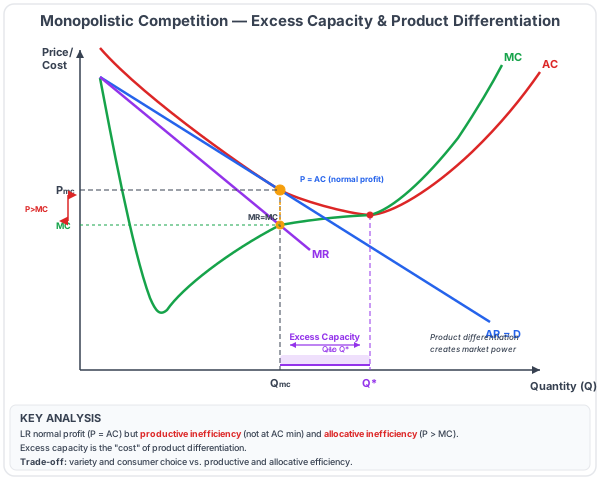
Mathematically, in monopolistic competition's long-run equilibrium, price exceeds average cost only insofar as the firm is earning supernormal profit, but entry drives supernormal profit to zero, so P = AC. However, the firm still sets MR = MC and charges price from the demand curve where P > MC. The gap between P and MC represents the firm's markup—the monopoly power created by differentiation. The firm underproduces relative to perfect competition (Q is lower), and the demand curve is tangent to the AC curve at an inefficient scale (typically to the left of minimum AC), creating excess capacity.
PART (B) — EVALUATE EXCESSIVE DIFFERENTIATION AND ADVERTISING
Product differentiation and advertising in monopolistic competition have both benefits and costs. The debate centers on whether the private benefits (to consumers who value variety) outweigh the social costs (excess capacity, wasteful advertising).
Benefits of differentiation: Consumers have choice—rather than all smartphones being identical, companies offer iPhones, Samsung, Google phones with different features and prices, allowing consumers to select products matching their preferences. Brand loyalty can reduce transaction costs and search time—buying Starbucks coffee daily is convenient rather than evaluating each coffee shop. Differentiation drives innovation—firms invest in R&D to create distinguishing features. Marketing communicates information—advertising informs consumers about new products and options. Without advertising, consumer search costs would be higher, reducing market efficiency. Differentiation also allows firms to segment markets (student discounts, luxury options), improving allocation.
However, costs are real: Excess capacity—many small competing firms each operate below minimum efficient scale, increasing average costs industry-wide. If the market could support one or two large firms at minimum scale, wasteful duplication is occurring. Advertising may be wasteful—competitive advertising by rival brands (Coca-Cola vs. Pepsi spending billions annually) largely cancels out, not genuinely informing consumers but rather competing for mindshare. This represents deadweight loss—resources spent on persuasion that don't increase overall consumption, just redistribute it. Barriers to entry from brand loyalty prevent efficient entry, even when potential competitors would be more efficient.
The classic example: cereal markets have 50+ brands competing fiercely through advertising, yet most cereals are very similar. The advertising costs are passed to consumers through higher prices, yet consumers might be equally satisfied with fewer brands at lower cost. Similarly, pharmaceutical advertising in the United States (drugs advertised on television) drives consumer demand but often doesn't reflect genuine innovation—me-too drugs with minor improvements command premium prices due to marketing rather than superior efficacy. These represent cases where product differentiation seems excessive relative to real consumer benefit.
The assessment depends on the sector and degree of differentiation. In some markets (fashion, consumer electronics, software), differentiation reflects genuine consumer preferences—people differ in style, functionality, and budget, so variety is valuable. In others (grocery items, basic medications), excess differentiation seems less justified. The empirical question is whether consumers value differentiation enough to offset the cost of excess capacity and advertising. If consumer willingness to pay for variety exceeds deadweight loss costs, monopolistic competition improves welfare; if it doesn't, perfect competition would be better.
Allocative efficiency requires P = MC; monopolistic competition fails this because P > MC, representing underallocation of resources to the product. Productive efficiency requires operating at minimum AC; monopolistic competition fails this due to excess capacity (operating to the left of minimum AC). However, monopolistic competition may produce dynamic efficiency—competition spurs innovation and product improvement. The overall welfare assessment requires weighing static inefficiency against dynamic efficiency gains. In fast-moving industries (technology, fashion, medicines), dynamic gains likely outweigh static losses. In stagnant industries (sugar, flour), static losses likely dominate.
Conclusion: Product differentiation and advertising are not inherently wasteful but can be excessive in specific contexts. Consumer variety is genuinely valued in many markets, and advertising provides useful information. However, competitive advertising that primarily shifts brand preference without informing represents deadweight loss. Policy implications: advertising regulations should distinguish informative advertising (allowed) from persuasive-only advertising (should be limited in certain sectors like alcohol, tobacco). Rather than restricting differentiation, policy should focus on limiting excess capacity through efficiency standards and preventing deceptive advertising. The strongest argument against excessive differentiation applies to sectors like pharmaceuticals where regulators could mandate generic alternatives, reducing wasteful advertising while preserving innovation incentives through patent protection.
Question 10: The Phillips Curve and the Unemployment-Inflation Trade-off
SL/HL Unit 3(b) Evaluate the view that shifts in the Phillips Curve make it unreliable as a guide for policymakers. [15 marks]
Explain Phillips Curve empirically observed, inverse relationship, policy trade-off
Discuss stagflation, expectations, NAIRU, and modern Phillips Curve shifts
PART (A) — EXPLAIN THE PHILLIPS CURVE
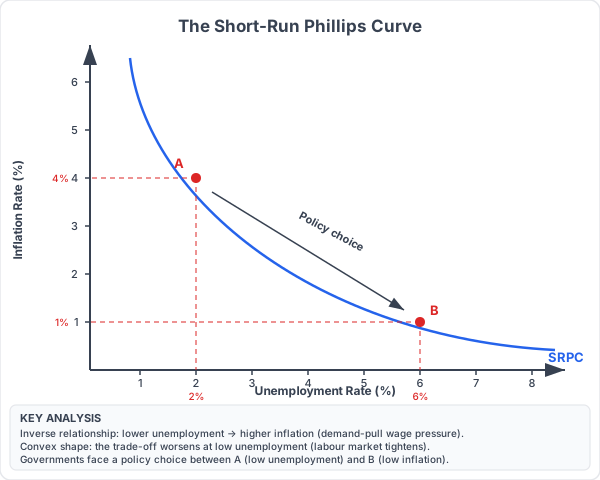
In 1958, A.W. Phillips published empirical evidence that inflation and unemployment in the UK were inversely related—when unemployment was low, inflation tended to be high, and vice versa. This became the "Phillips Curve." Intuitively, the relationship reflects labor market dynamics: when unemployment is low (labor scarce), workers demand higher wages, firms face rising labor costs, and prices rise. When unemployment is high (labor abundant), workers lack bargaining power, wage growth slows, and inflation moderates. This seemed to provide a stable trade-off that policymakers could exploit.
The policy trade-off implication was significant: governments could choose their preferred point on the Phillips Curve. Prefer lower unemployment and higher inflation? Easy—use expansionary policy. Prefer lower inflation? Accept higher unemployment. This offered an apparent menu of choices, and most governments in the 1960s chose expansion and moderate inflation, assuming the trade-off was stable. President Kennedy's advisors deliberately aimed for lower unemployment (around 4%) even if it required accepting higher inflation.
The mechanism: expansionary fiscal or monetary policy increases aggregate demand. Firms increase production and hiring, unemployment falls. Scarcer labor gives workers bargaining power—wage demands rise. Firms raise prices to cover higher wage bills, causing inflation. A simple Phillips Curve relationship: % inflation = a - b×(unemployment rate), where higher unemployment pushes inflation down. The trade-off seemed immutable—there appeared to be no way to reduce both unemployment and inflation simultaneously.
Empirically, Phillips' original data showed a clear inverse relationship: 3% unemployment correlated with 5% inflation, 4% unemployment with 2% inflation, etc. The curve was reasonably stable from 1900-1960, giving confidence in its reliability. The original Phillips Curve omitted expectations—it was a nominal relationship between inflation and unemployment. This was the original curve's strength (empirical stability) and weakness (it ignored expectations, which later economists recognized were crucial).
PART (B) — EVALUATE PHILLIPS CURVE RELIABILITY
The Phillips Curve proved unreliable, particularly in the 1970s. Stagflation—simultaneous high unemployment and high inflation—contradicted the Phillips Curve entirely, demonstrating the relationship could shift. However, the Phillips Curve in modified form (expectations-augmented) remains useful for policymakers, though with important caveats.
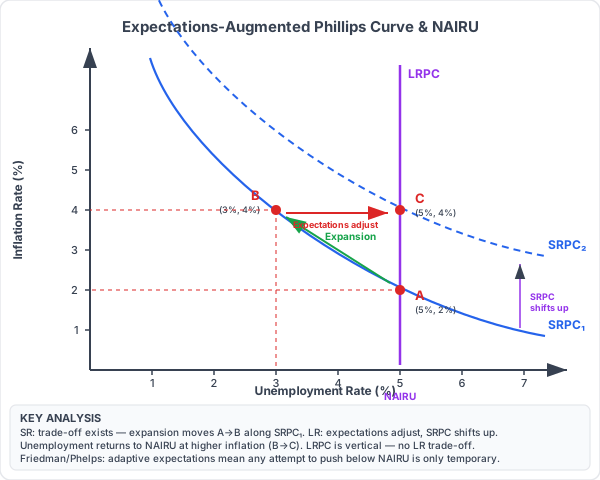
The 1970s breakdown was dramatic. In 1974, the US experienced 5.5% unemployment and 12% inflation simultaneously—the exact opposite of the Phillips Curve prediction. This stemmed from oil price shocks (OPEC embargo) that shifted the aggregate supply curve leftward, and from expectations becoming important. When inflation reached 10% (from 1960s expansionary policies), workers and firms expected continued inflation. Workers demanded wage increases to maintain purchasing power, and firms expected to pass inflation through. This wage-price spiral meant inflation could persist despite high unemployment—stagflation occurred. The original Phillips Curve failed to account for expectations.
The expectations-augmented Phillips Curve, developed by Milton Friedman and Edmund Phelps, accounts for this: inflation = inflation expectations + a - b×(unemployment). Only surprise inflation (actual inflation exceeding expected inflation) reduces unemployment. If people expect 10% inflation and it occurs, unemployment is unchanged; if 11% inflation occurs, unemployment temporarily falls (people confused about real vs. nominal wages), but when expectations adjust to 11%, unemployment returns to the natural rate. This explains how stagflation occurred: inflation expectations kept unemployment high even as actual inflation rose.
Modern monetary policy uses a modified Phillips Curve incorporating expectations, resource slack, and inflation anchoring. The Federal Reserve targets 2% inflation and adjusts interest rates based on deviations of unemployment from the natural rate and inflation expectations. However, the Phillips Curve's reliability varies. In the 1990s-2000s, the Phillips Curve seemed broken—unemployment fell to 3.5% (late 1990s) with minimal inflation, contradicting the original relationship. This reflected globalization (imports competed domestically, limiting wage growth despite low unemployment) and better inflation expectations (anchored by credible central banks targeting low inflation). In the 2010s after the financial crisis, the Phillips Curve was flat—unemployment fell from 10% (2009) to 3.5% (2019) with little inflation pickup.
However, 2021-2023 saw Phillips Curve re-shift. With aggressive stimulus and supply-chain disruptions, inflation surged despite moderate unemployment, suggesting the trade-off returned. This raises questions: Did the Phillips Curve flatten temporarily due to specific conditions (globalization, low inflation expectations) that have now reversed? Or is there a permanent structural change? Policymakers must remain agnostic—the Phillips Curve shifts based on expectations, supply shocks, and labor market structure, making it unreliable as a stable guide.
The concept of the Non-Accelerating Inflation Rate of Unemployment (NAIRU) is central to modern understanding. The NAIRU is the unemployment rate consistent with stable inflation—below NAIRU, inflation accelerates; above it, inflation decelerates. The Phillips Curve describes the relationship near the NAIRU. However, NAIRU itself shifts with expectations, hysteresis effects (long-term unemployment persistence), labor force participation, and skill mismatches. Estimating NAIRU is uncertain—Federal Reserve estimates in 2015 ranged from 4.5% to 5.5%, making policy guidance imprecise. Central banks now use broader measures—output gaps, inflation expectations surveys, wage growth—rather than relying solely on unemployment-inflation relationship.
Conclusion: The original Phillips Curve is unreliable as a stable guide, particularly across different economic periods and inflation regimes. However, the expectations-augmented Phillips Curve, modified for supply shocks and shifting expectations, remains a useful framework for understanding inflation dynamics. Modern policy doesn't rely on the Phillips Curve as a mechanical trade-off but rather as one indicator among many. Policymakers should recognize that the unemployment-inflation relationship is conditional on expectations anchoring and supply conditions—maintaining credible commitment to low inflation expectations (through central bank credibility and forward guidance) is more important than exploiting any Phillips Curve trade-off. The lesson is that in an era of adaptive expectations, attempts to exploit trade-offs shift the trade-off itself, undermining the policy's effectiveness. Credible, rules-based monetary policy that stabilizes expectations is superior to discretionary policy based on unstable Phillips Curve relationships.
Question 11: Foreign Aid and Economic Development
HL Unit 5(b) Evaluate the effectiveness of foreign aid as a tool for promoting sustainable development in low-income countries. [15 marks]
Define aid types, explain humanitarian, development, and strategic motivations
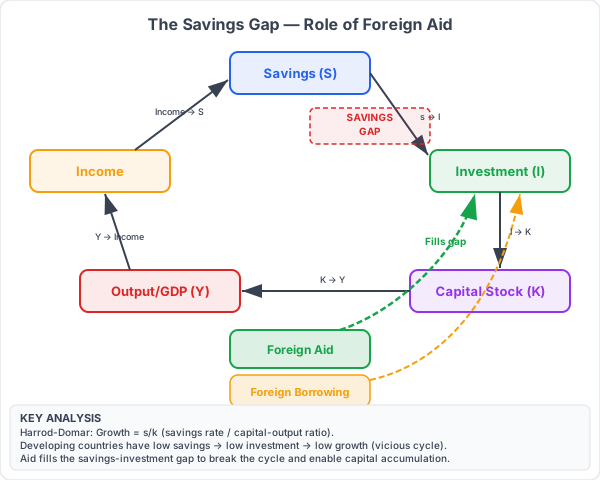
Discuss: aid effectiveness paradox, corruption, dependency, aid fragmentation
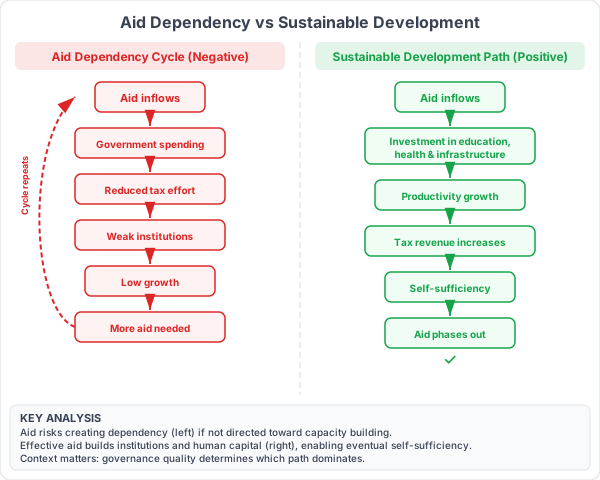
PART (A) — EXPLAIN FOREIGN AID PURPOSES AND MOTIVATIONS
Foreign aid is transfer of resources (cash, goods, expertise) from one country to another. It takes multiple forms: humanitarian aid (emergency relief for disasters, famines, refugees), development aid (long-term infrastructure, health, education projects), and technical assistance (training, advice). Donor motivations vary: humanitarian concern for human suffering, genuine desire to promote development, geopolitical interests (gaining allies, countering rival powers), and commercial interests (promoting exports through tied aid). Most donor countries mix multiple motivations.
Official Development Assistance (ODA) is the formal aid category, defined as concessional transfers (loans on easier terms than market rates, or grants) aimed at development. Wealthy nations commit to spending 0.7% of GNI on ODA (though few meet this target). Types include bilateral aid (country to country), multilateral aid (through organizations like World Bank), and untied aid (recipient can choose where to purchase goods) versus tied aid (must buy from donor country).
Humanitarian motivations are important—Western countries mobilized aid after the 2004 Indian Ocean tsunami, and donor countries provide food aid during famines in Africa. However, geopolitical motivations sometimes dominate. During the Cold War, US and Soviet aid were largely motivated by containing each other's influence—the US supported anti-communist dictators in Latin America and Asia while the Soviets supported communist allies. Modern examples include competition for influence in Africa and the Pacific, where China and Western countries both provide large aid packages partly to win geopolitical favor.
Commercial interests drive tied aid. Japan's aid historically has been heavily tied, requiring recipient countries to use Japanese contractors and purchase Japanese goods. This benefits Japanese companies but reduces aid effectiveness—recipients can't buy from cheapest suppliers, paying premium prices that waste aid resources. US agricultural aid is often tied to US suppliers, increasing costs by 20-30% relative to purchasing locally. Tied aid can be economically harmful—it inflates prices, reduces domestic agricultural incentives in recipient countries, and creates dependency.
Aid can be analyzed as either altruistic (pure humanitarian concern, using economic resources for others' benefit) or strategic (serving donor interest). Formal development theory recognizes that aid can serve both simultaneously—helping poor countries while advancing donor security or trade interests. The fungibility problem: if a donor gives aid for schools but the recipient government diverts that money to military spending, aggregate aid might not increase school spending. Additionality—whether aid adds to recipient government spending or replaces it—is a key concern for aid effectiveness.
PART (B) — EVALUATE AID EFFECTIVENESS
The effectiveness of foreign aid is empirically mixed and remains contested among development economists. Aid can succeed in specific contexts but has limited overall impact on development, with significant risks of corruption and dependency. The relationship between aid and growth is weak in aggregate studies, suggesting that how aid is used matters much more than the aid amount.
Successes are documented: Smallpox eradication was achieved through coordinated international aid; malaria bed net distribution programs funded by Global Fund have saved millions of lives; education aid has funded school construction and teacher training, raising literacy in many developing countries. Botswana's development was supported by effective aid deployment—donors funded human capital investment, and Botswana's governance ensured efficient use. Bangladesh's economic progress involved aid contributions to health and education. Some infrastructure projects funded by aid (dams, roads) generated long-term productivity benefits.
However, aggregate evidence is weak. Econometric studies (by Boone, Easterly, others) found no consistent relationship between aid and economic growth across countries. Zambian economist Dambisa Moyo argues aid has often harmed development—creating government dependence on foreign transfers rather than tax revenue, reducing accountability; funding consumption rather than investment; and enabling corrupt elites to avoid taxing themselves. Countries heavily dependent on aid (some sub-Saharan African countries receiving 50%+ of government spending as aid) often have weak governance—without needing tax revenue, governments don't develop institutional capacity or respond to citizens.
Real problems in aid delivery: Corruption—aid is diverted to official pockets in recipient countries; fragmentation—many donors create administrative burden; tied aid raises costs; conditionality (donors impose policy requirements) can be paternalistic and counterproductive; misaligned incentives (donors want visible projects, recipients want infrastructure). Rwanda received aid for genocide prevention but aid was diverted and failed to prevent the 1994 genocide. Democratic Republic of Congo has received enormous aid but experiences slow growth and persistent poverty—suggesting aid alone cannot overcome poor governance and political instability.
When is aid effective? Evidence suggests: (1) In countries with strong governance and institutions—aid to countries with good policies multiplies in effectiveness; (2) For specific projects with clear objectives and monitoring—health and education aid works better than general budget support; (3) Untied, coordinated aid with minimal conditionality; (4) When recipients have ownership and agencies align incentives. South Korea and Taiwan both received significant aid in the 1960s-70s but combined it with strong domestic institutions and export-led growth strategies, so aid contributed to success. Countries like Chad and Central African Republic received similar amounts but poor governance prevented effectiveness.
The "aid paradox" describes why aid has weak aggregate effects despite successful individual projects. Aid works within specific sectors (vaccination campaigns, school construction) but doesn't translate to broad growth if underlying institutions, governance, and policy frameworks are weak. Econometric analysis must distinguish between project-level and country-level effects. The problem of selection bias—donors tend to help countries with better prospects anyway, making causality difficult to assess. Randomized controlled trials (RCTs) in development economics provide clearer evidence for specific interventions but don't resolve the macroeconomic question of aid's overall growth impact.
Conclusion: Foreign aid is an effective tool for specific humanitarian and development objectives—reducing disease, improving education, providing disaster relief—but is not a reliable driver of sustained economic development. The weak aggregate aid-growth relationship suggests that domestic factors (governance, institutional quality, investment in human capital, macroeconomic stability) matter much more than aid levels. The most effective development strategies combine moderate aid with strong domestic policy—aid is a supplement to, not substitute for, good domestic governance and investment. Donor countries should focus on targeted, untied aid for specific outcomes (health, education), provide technical assistance for institutional building, and resist using aid for geopolitical purposes. Recipients must prioritize governance improvements and domestic resource mobilization over aid dependence. The role of aid is supporting development, not causing it; development ultimately requires local effort.
Question 12: Public Goods and Market Failure
SL/HL Unit 2(b) Evaluate whether government provision is the best solution to the public goods problem. [15 marks]
Define public goods (non-rivalry, non-excludability), explain free-rider problem
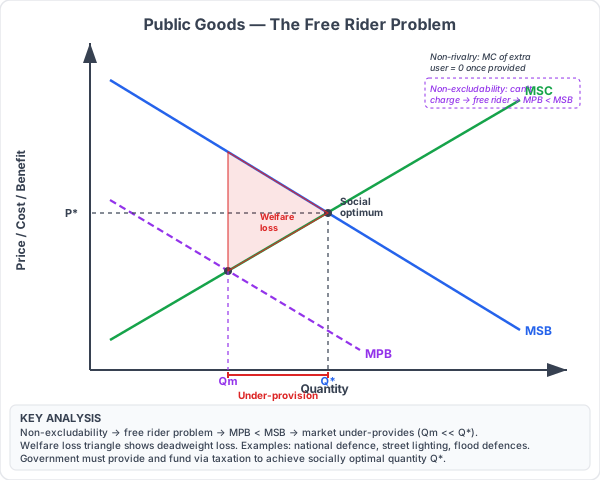
Discuss: government provision limitations, private alternatives, hybrid models
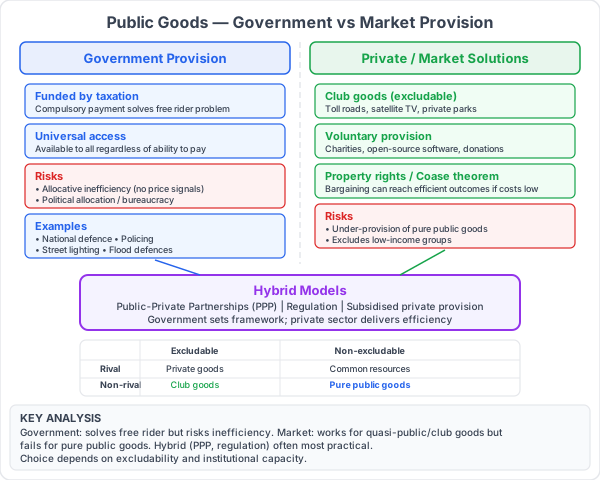
PART (A) — EXPLAIN PUBLIC GOODS AND MARKET FAILURE
A public good has two characteristics: (1) Non-excludability—once provided, it is impossible or very costly to exclude anyone from consuming it; (2) Non-rivalry—consumption by one person does not reduce availability to others. National defense is the classic example—once a defense system protects a country, all citizens benefit and cannot be excluded; one person's protection doesn't reduce others' protection. Lighthouses benefit all ships, clean air benefits all people breathing it. These characteristics mean markets fail—private firms cannot charge for public goods effectively because they cannot exclude non-payers (free riders).
The free-rider problem is fundamental. If a lighthouse operator tries to charge ships for navigation service, ships refusing to pay cannot be excluded from using the light (it shines for free to all). Knowing this, most ships won't pay, and the lighthouse operator cannot recover costs. The free-rider problem means private provision is unprofitable, even though society would benefit from lighthouse provision. Markets undersupply public goods—the quantity supplied is below the socially optimal quantity where marginal social benefit equals marginal social cost.
Real examples: National defense—no private company can profitably defend a nation; all citizens benefit from being in a defended country, but most would free-ride and not pay for it voluntarily, so private defense provision fails. Basic scientific research—pharmaceutical companies benefit from basic research discoveries but cannot monopolize them (competitors can use discoveries freely), so they underinvest in basic research relative to optimal levels; government funding of research (NIH, NSF) addresses this. Flood control dikes—protecting one person from flooding protects nearby people; a private firm building dikes would struggle to charge all beneficiaries and would undersupply dike provision.
The demand for public goods is determined by summing vertically—at each quantity, willingness to pay from all consumers is added, creating the social demand curve (unlike private goods where demand is summed horizontally: everyone pays the price per unit). Optimal provision occurs where marginal social benefit (vertically summed marginal benefits) equals marginal social cost. Private markets only capture private willingness to pay, ignoring others' benefits, leading to underallocation. This is market failure due to positive externalities (each person's consumption of public goods benefits others) and the inability to enforce payment (non-excludability).
PART (B) — EVALUATE GOVERNMENT PROVISION
Government provision of public goods is justified by the free-rider problem but faces its own challenges: inefficiency, limited innovation, political interference, and cost control difficulties. Alternative mechanisms exist and may sometimes be superior.
Government provision through taxation forces everyone to contribute to public goods, overcoming the free-rider problem. Government can decide optimal quantity through democratic processes and provide efficiently through bulk purchasing and economies of scale. Government-provided public goods work reasonably well—national defense, roads, primary education, basic research, public health are substantially government-provided in most countries and function adequately. Government provision can include equity—making goods accessible to all regardless of income. Roads are provided to remote areas with few users; government provision ensures universal access that profitable private provision wouldn't offer.
However, government provision has limitations: Government may overprovide or underprovide public goods based on political cycles rather than actual demand—a government facing election might overspend on visible projects (highways) while underfunding less visible ones (maintenance, sewers). Inefficiency—governments often operate monopolies without competitive pressure, leading to high costs and poor quality. Innovation—government-provided goods may not improve rapidly; government hospitals often lag behind private hospitals in technology; government research sometimes lacks flexibility of private R&D. Rent-seeking—politicians and bureaucrats may use public good provision to benefit special interests rather than the public.
Private and hybrid alternatives exist: Some public goods can be privatized through property rights assignment—instead of government-provided roads, toll roads are privately operated and users pay; excludability is created, solving the free-rider problem. Private universities and hospitals provide goods with public good characteristics. Private security companies provide security for neighborhoods. Property rights creation (patents, copyrights) incentivizes innovation in research and culture. These alternatives work when excludability can be created without excessive cost. However, some public goods resist privatization—excluding people from clean air is impossible (or prohibitively costly); charging for national defense is impractical.
Mixed models sometimes work best: Public-private partnerships (PPPs) combine government funding (ensuring universal provision, equity) with private management (ensuring efficiency, innovation). Singapore's healthcare system is substantially private but heavily government-subsidized, combining equity with efficiency. UK rail infrastructure is publicly owned but privately operated through franchises, combining public ownership with private management incentives. Development aid increasingly uses PPPs—government funds development (e.g., hospitals) but private firms operate them, potentially improving efficiency.
The optimal solution depends on the specific public good and context. For pure public goods (national defense, clean air, basic research) where excludability is impossible, government provision or subsidies are necessary. For partially excludable goods (education, healthcare, roads), mixed systems combining government support with private provision can be effective. For goods where excludability can be feasibly created (toll roads, entertainment, security), private provision with regulation may be superior. The key principle: use market mechanisms where feasible (property rights, fees, competition), use government only for genuine public goods where markets fail completely.
Quasi-public goods (education, healthcare) have externalities and non-excludability elements but are partly excludable—you can charge tuition, though equity suffers. These are best served through hybrid provision: government ensures universal access and subsidizes the poor, while private provision serves those willing to pay premium prices. The concept of congestion—public goods like roads become rival once congested (addition of users reduces others' quality); toll pricing during congestion periods (London congestion charge) creates excludability and improves efficiency. Dynamic provision—with technology, goods can shift categories; telecommunications was once a natural monopoly (excludable) but technology made it competitive; internet access has partially public-good characteristics (network effects, external benefits) and partly private (excludable).
Conclusion: Government provision is justified for pure public goods where markets fail due to non-excludability and non-rivalry. However, government is not automatically the best provider—it faces efficiency, innovation, and political problems. The optimal approach matches provision mechanism to the good: purely public goods require government (or government subsidy); partially public goods benefit from mixed provision (government funding + private/hybrid operation); goods where excludability is feasible may be best left to markets with regulation. Developing countries with weak institutions should focus on government-provided basics (primary education, basic health) through tax financing, using the savings from better enforcement and less corruption to improve quality. Wealthy countries can afford more sophisticated mixed systems. The underlying principle—use markets where they work, use government only where necessary—is more useful than blanket advocacy for public or private provision.