A Level Micro Essays
Master micro-economics essay writing with practice questions and model answers covering Edexcel A Level themes.
AO Legend
About This Page
Mark Allocation: Each essay is marked out of 25 marks on the Edexcel A Level Economics specification.
AO Breakdown (Indicative):
- AO1 (Knowledge): Demonstrate clear understanding of economic concepts, principles, and analysis. Accurate definitions and appropriate use of economic terminology (0-5 marks).
- AO2 (Application): Apply economic knowledge and understanding to analyse the specific context or scenario. Use relevant examples and data (0-5 marks).
- AO3 (Analysis): Analyse the effects of economic decisions, actions, or changes using diagrams, models, and chains of reasoning. Show cause-and-effect relationships (0-8 marks).
- AO4 (Evaluation): Evaluate the relative importance, benefits, drawbacks, limitations, and alternative approaches. Reach supported conclusions (0-7 marks).
How to Use: Write your own response in each textbox, then toggle the model answer to compare. Model answers are exam-quality examples, not perfect papers.
Student Response
An indirect tax is a tax imposed on the production or sale of goods and services, collected by sellers and passed to the government. Negative externalities occur when the production or consumption of a good creates costs external to the market transaction, not reflected in the price. Examples include pollution from petrol consumption or health costs from alcohol. The free market equilibrium fails because the price does not account for these external costs; producers and consumers only consider private costs, not social costs. An indirect tax can be used to address this market failure by artificially increasing the price faced by consumers, thereby internalizing the external cost and moving the market closer to the socially optimal equilibrium.
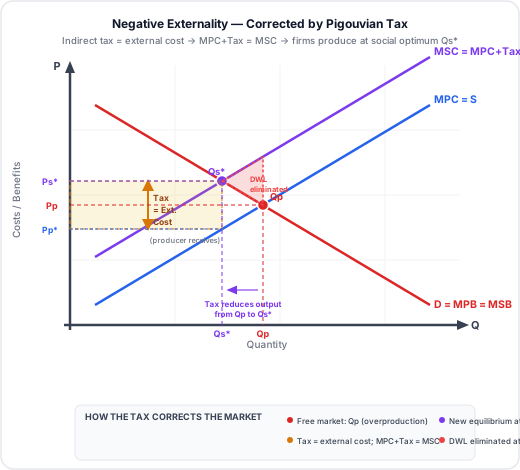
Graphically, an indirect tax shifts the supply curve upward (or the aggregate supply curve left in a 2D diagram). If the tax equals the marginal external cost (MEC), the after-tax supply curve aligns with the social cost curve. The market equilibrium moves from the intersection of demand and private supply (MPB = MPC) to a new point where demand meets the socially optimal supply. At this new equilibrium, quantity demanded falls and price rises, reducing consumption and the associated negative externality.
In the UK, fuel duty is a prime example of an indirect tax on goods generating negative externalities. Petrol and diesel consumption create carbon dioxide emissions, contributing to climate change, and cause local air pollution and congestion costs. The UK fuel duty of approximately 57.95 pence per litre (as of 2024) is designed to internalize some of these external costs. Similarly, the sugar tax (soft drinks industry levy) introduced in 2018 specifically targets goods linked to negative health externalities (obesity, type 2 diabetes). These taxes have demonstrably reduced consumption: soft drinks sales fell by around 30% in the year following the tax's introduction, suggesting that price sensitivity is significant for health-related goods.
Alcohol and tobacco duties in the UK provide further evidence. Duty on a bottle of wine is approximately £2.16, and tobacco duty ensures a packet of cigarettes costs minimum £10.90. These taxes have contributed to reduced smoking rates (from 27% of adults in 1990 to approximately 15% in 2024) and declining alcohol consumption among young people. The government's stated goal is to use these fiscal instruments to discourage harmful consumption while raising revenue, demonstrating multi-objective policymaking in practice.
[Diagram description: A supply and demand diagram with initial equilibrium at Q1, P1 (where D = S, private supply). A tax shifts the supply curve upward by the amount of the tax (ΔT), creating a new supply curve S+tax. The new equilibrium is at Q2, P2 (where D = S+tax), with Q2 < Q1 and P2 > P1.] The imposition of an indirect tax causes an inward shift of supply, reducing equilibrium quantity from Q1 to Q2 and raising the consumer price from P1 to P2. Crucially, this reduces the quantity consumed of the good generating negative externalities. The deadweight loss (DWL) from the original market failure—the area between demand and social marginal cost curves—is reduced. If the tax is set equal to the marginal external cost at the original quantity, the new equilibrium achieves allocative efficiency (where P = SMC).
The magnitude of the consumption reduction depends on the price elasticity of demand. Goods with price-inelastic demand (e.g., essential medicines, cigarettes in the short term) show smaller consumption reductions; goods with elastic demand show larger reductions. For petrol, the long-run price elasticity of demand in the UK is estimated at approximately -0.5 to -0.7, meaning a 10% price increase leads to a 5-7% reduction in quantity consumed. This illustrates the inverse relationship: less elastic goods require larger tax rates to achieve significant consumption reductions, raising questions about proportionality and effectiveness.
A significant limitation is the regressive nature of indirect taxes on externality-generating goods. Fuel duty, for instance, represents a higher percentage of income for low-income households, who spend proportionally more on transport and heating. The Institute for Fiscal Studies found that the poorest fifth of households pay approximately 7% of income in fuel duty versus 2% for the richest fifth, raising equity concerns. This regressive impact may outweigh environmental benefits, particularly without complementary measures like subsidies for public transport or fuel allowances for disadvantaged groups.
Second, the effectiveness of indirect taxes relies on accurate knowledge of the marginal external cost. If policymakers set the tax too low, overconsumption persists; if too high, deadweight loss occurs. Estimating the social cost of carbon or health costs from alcohol involves considerable uncertainty, and costs vary regionally and temporally. Third, tax evasion and avoidance reduce effectiveness: smuggling of cigarettes into the UK has risen significantly, undermining the public health aims of tobacco duty. Fourth, behavioural responses may differ from neoclassical predictions; some consumers may switch to untaxed substitutes (e.g., illicit alcohol) rather than reduce consumption. Finally, alternative policy approaches such as regulation (banning the worst pollutants), subsidies for clean alternatives (electric vehicles), or tradable permit systems (carbon credits) may be more effective or equitable in specific contexts, particularly when the magnitude of externalities is extreme or when distributional impacts must be minimized.
Student Response
A monopoly is a market structure with a single seller of a product with no close substitutes and significant barriers to entry. Barriers to entry (e.g., economies of scale, legal barriers, brand loyalty, control of resources) prevent potential competitors from entering the market. A monopoly exercises market power by setting price above marginal cost, thereby earning abnormal (supernormal) profits in the long run. Unlike perfect competition, where firms are price-takers and set P = MC, monopolies are price-makers and set output where MR = MC, then charge the price on the demand curve above that output level. This results in allocative inefficiency: price exceeds marginal cost, meaning the marginal benefit to society (price) exceeds the marginal cost of production, so resources are underallocated to that good. Furthermore, monopolies may face weaker incentives to minimize costs (X-inefficiency), leading to productive inefficiency.
The "public interest" broadly refers to the aggregate welfare of consumers and producers, maximized under allocatively and productively efficient outcomes. Consumer surplus is higher under competition, and society experiences lower deadweight loss. Traditional economic theory suggests monopolies exploit consumers by restricting output and raising prices, harming the public interest through reduced consumer surplus, allocative inefficiency, and potential rent-seeking behaviour (spending resources on maintaining monopoly power rather than productive activity).
Royal Mail exemplifies a historical near-monopoly on letter delivery in the UK. For decades, Royal Mail operated with a legal monopoly protected by the Postal Services Act. Critics argued this harmed consumers through high stamp prices (a first-class stamp cost 81 pence in 2024) and service delays. Similarly, pharmaceutical firms holding patents on life-saving drugs (e.g., Gilead's price of $84,000 per course for Hepatitis C drug Sovaldi) exercise monopoly power, restricting access and raising questions of public health versus profit. Network Rail, as the monopoly infrastructure owner for UK railways, has been critiqued for high maintenance costs and service issues, suggesting inefficiency and rent-seeking.
However, consider Google's near-monopoly in search (approximately 92% UK market share as of 2024). Google has massively invested in AI and data infrastructure, providing free search to billions. Consumers benefit from superior technology and convenience, though privacy concerns and ad-market power remain contentious. Microsoft's past dominance in operating systems was challenged partly because consumers felt locked into an inferior product; yet innovations like the graphical user interface emerged partly due to R&D scale.
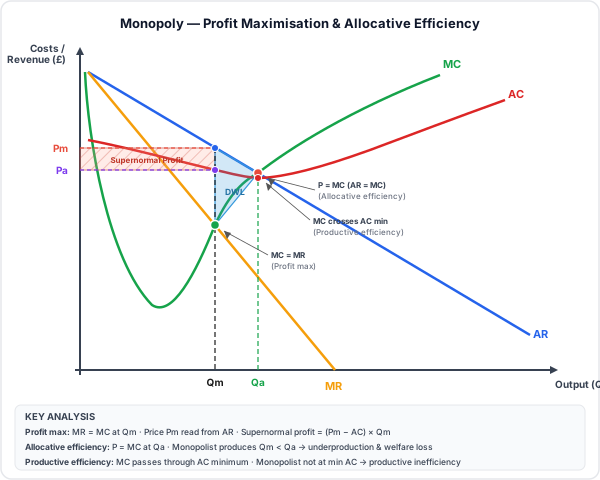
[Diagram A (Monopoly vs. Competition): A diagram showing demand (D), marginal revenue (MR), and marginal cost (MC) curves. The monopoly sets output Qm where MR = MC and charges Pm from the demand curve. A perfectly competitive firm would set output Qc where P = MC (demand = MC). As a result, Qm < Qc, Pm > Pc.] The monopoly restriction of output from Qc to Qm creates deadweight loss: the area between the demand curve and MC curve between Qm and Qc represents lost gains from trade. Consumer surplus falls from the competitive level, and whilst the monopolist gains producer surplus, the net social loss (deadweight loss) is a loss to society overall. This illustrates allocative inefficiency and the core economic argument against monopolies.
[Diagram B (Cost curves): A diagram showing Average Total Cost (ATC) and Average Revenue (AR = Demand) curves for a monopoly. The monopoly might earn abnormal profit (P > ATC at equilibrium output).] If the monopoly is productively inefficient (not operating at minimum ATC), this represents further welfare loss. Additionally, rent-seeking behaviour—expenditure on lobbying, advertising, or legal battles to maintain monopoly power—represents resources diverted from productive uses, further reducing social welfare. The extent of deadweight loss depends on the elasticity of demand: more elastic demand limits monopoly power and deadweight loss; inelastic demand permits greater price increases and larger deadweight loss.
The statement "monopolies are always against the public interest" is an overstatement. In certain contexts, monopolies can benefit society. Natural monopolies—industries with declining average costs over a wide range of output due to large fixed costs (e.g., water supply, electricity distribution networks)—are more efficient as single producers than multiple competitors. Breaking up a natural monopoly would increase average costs, harming consumers through higher prices. The UK water and sewage industry operates as regional monopolies but is heavily regulated by Ofwat to protect consumers. Regulation (price caps, quality standards) may be more efficient than fragmentation.
Second, monopolies with significant economies of scale can invest heavily in innovation and R&D. Pharmaceutical firms rely on patent monopolies to fund drug development; without patent protection, R&D would be underfunded, and life-saving medicines would not emerge. Similarly, large tech monopolies (Google, Amazon) invest in advanced AI, cloud infrastructure, and logistics innovation that benefits consumers in the long run. The dynamic efficiency gains from monopoly innovation may outweigh the static allocative inefficiency losses in some sectors. Third, monopolies can achieve lower costs through economies of scale, benefiting consumers through lower prices once regulation is applied (e.g., telecommunications after privatization with regulation). Fourth, some monopolies arise from superior product quality or efficiency, not barriers to entry. Apple achieved near-monopoly status in premium smartphones through innovation; consumers benefit from superior design and technology.
The public interest is therefore context-dependent. In competitive industries with low barriers to entry, monopolies are harmful and should be broken up or prevented through competition policy. In natural monopolies or highly innovative sectors, regulation is preferable to fragmentation. The UK's approach—competition law via the Competition and Markets Authority (CMA) to prevent abuse of dominance, combined with regulation for natural monopolies and patent protection for innovation—reflects this nuance. Rather than viewing all monopolies as inherently against the public interest, a case-by-case assessment of market structure, barriers to entry, innovation incentives, and scope for regulation is needed.
Student Response
A public good is a product with two defining characteristics: non-rivalry in consumption (one person's use does not reduce availability for others) and non-excludability (it is impossible or prohibitively costly to exclude non-payers from consuming the good). National defence exemplifies both: my protection from an air strike does not reduce yours, and non-residents cannot be excluded once defence is provided. Street lighting and lighthouses similarly display non-rivalry and non-excludability. Because of non-excludability, private firms cannot charge users for public goods; free riders benefit without paying. This creates a market failure: even if the marginal benefit to society from providing more of a public good exceeds the marginal cost, private firms will not produce it because they cannot capture the benefits through price. The private market therefore underprovides or fails to provide public goods entirely, leading to allocative inefficiency.
Government intervention can address this by providing public goods directly (e.g., NHS healthcare, state education) or by funding provision through taxation. Because government can enforce taxation, it compels payment via non-price mechanisms, bypassing the free rider problem. Taxation transfers resources from private consumption to public provision. The demand for a public good is calculated by vertical summation of individual demand curves (unlike private goods, where demand is horizontal summing), because all individuals consume the same quantity simultaneously. Government provision at the level where Price (derived from the vertically summed demand curve) = Marginal Cost ensures allocative efficiency and corrects the market failure.
The NHS represents a successful government intervention addressing market failure in healthcare. Without state provision, a private market would underprovide healthcare to low-income patients (free rider problem and inability to pay). The UK government funds NHS through general taxation (approximately £180 billion annually in 2024), providing healthcare services to all. Citizens did not individually demand NHS formation through price signals; rather, government recognized the social benefit of universal healthcare provision and implemented intervention. Similarly, UK Defence spending (£66.5 billion in 2024) funds military services; private defence markets would likely result in free riders and undersupply of national security. No individual can be excluded from national defence benefits once provided.
State education (funded by £82 billion government spending in 2024) illustrates another public good: education generates positive externalities (social benefits beyond individual benefit), and non-excludability arises in primary/secondary education funded through progressive taxation. Street lighting and national parks are publicly funded because private provision would underfunding due to non-excludability. The BBC (funded by the television licence fee of £159 in 2024) is partially a public good model, funded through mandatory contribution rather than price, ensuring broadcast of educational/cultural content that might be underprovided by purely commercial providers. These examples demonstrate government intervention correcting market failures in public goods provision.
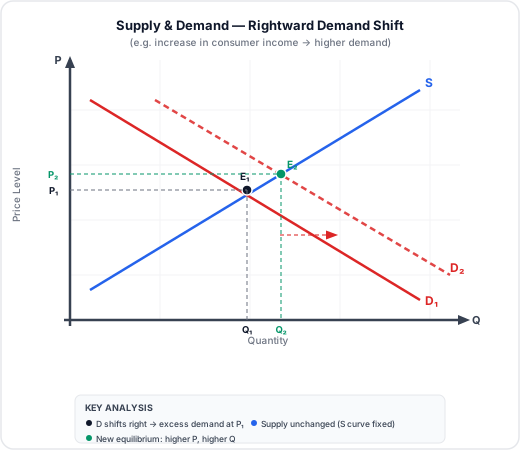
[Diagram A (Public Good Demand and Provision): A diagram with individual demand curves D1 and D2, vertically summed to create the demand curve for the public good (Dmarket = D1 + D2). The marginal cost of provision (MC) is shown as a horizontal or slightly upward-sloping curve. The optimal provision occurs where Dmarket = MC (point E), at quantity Q* and price P*. A private market at a lower price would demand less than Q*, creating underprovision relative to the allocatively efficient level.] Because individual demand curves are vertically summed for public goods (each consumer receives the full quantity), the aggregate marginal benefit at any quantity is higher than for a single consumer. A private firm, observing only one consumer's demand curve, would underprovide. Government provision at Q* (where summed demand = MC) ensures allocative efficiency. If the true willingness to pay aggregated across society exceeds the marginal cost, provision at Q* maximizes total surplus.
Taxation mechanisms fund government provision. A proportional, progressive, or lump-sum tax redistributes purchasing power from private consumption to public goods provision. The deadweight loss of taxation (loss of consumer and producer surplus) is weighed against the allocative gain from providing the public good. If the allocative gain from public good provision exceeds the deadweight loss from taxation, net social welfare increases. Government intervention thus restores allocative efficiency by forcing individuals to reveal their preferences for public goods collectively (through voting and taxation) rather than through private price signals. The provision of streetlights in UK cities, for example, ensures that all citizens benefit from improved safety and visibility, a benefit that private markets would not furnish due to free rider constraints.
However, government intervention has significant limitations, termed "government failure." First, information problems arise: government officials may lack accurate knowledge of citizens' true preferences for public goods. How much should be spent on defence versus healthcare? Voting mechanisms (democracy) attempt to aggregate preferences but may not reflect intensity of preference or long-term societal interests. Second, even with taxation, government may misjudge the optimal provision level. Oversupply of public goods wastes resources; undersupply perpetuates inefficiency. The UK spends approximately 9.8% of GDP on public services (2024), but debate persists about whether NHS funding is sufficient or excessive, indicating uncertainty in provision levels.
Third, crowding out effects may occur: government spending on public goods financed by taxation reduces private investment and consumption, potentially slowing economic growth. If business investment and entrepreneurial activity fall due to higher corporate taxes funding public provision, long-term productivity and innovation may suffer. Fourth, political motivations may distort government provision. Politicians may overfund popular projects or underfund politically unpopular public goods (e.g., climate adaptation measures require long-term investment with uncertain electoral benefits). This political short-termism reduces the effectiveness of government intervention. Fifth, opportunity cost and efficiency concerns arise: government provision may be productively inefficient. NHS waiting times have increased significantly (average wait for non-urgent procedures exceeded 18 weeks in 2024), suggesting inefficiency despite government funding. Private alternatives might deliver services more cheaply, but equity concerns (access for low-income patients) justify public provision despite inefficiency.
In conclusion, government intervention substantially corrects market failure in public goods by overcoming the free rider problem through compulsory taxation and direct provision. For pure public goods with complete non-excludability and non-rivalry (defence, street lighting), government intervention is necessary and effective. However, intervention does not fully eliminate market failure in all contexts: government failure through information asymmetries, political motivations, and productive inefficiency means outcomes are imperfect. Mixed approaches—government provision with competition (e.g., regulated private delivery of NHS services), user charges where feasible to reveal preferences (congestion pricing for roads), and international coordination for global public goods (climate change mitigation)—may better balance public good provision with efficiency incentives. The extent to which government intervention corrects public good market failure is therefore substantial but incomplete, varying by sector and implementation design.
Student Response
A maximum price (price ceiling) is a government-imposed upper limit on the price that can be legally charged for a good or service. To be effective, the maximum price must be set below the equilibrium price; if set at or above equilibrium, it has no binding effect since the market would naturally clear at the lower price. When a price ceiling is imposed below equilibrium, it creates excess demand (shortage): at the legal price ceiling (Pmax), quantity demanded exceeds quantity supplied. The shortage equals the difference between quantity demanded and quantity supplied at Pmax. This differs from a free market equilibrium where price adjusts to clear the market. The shortage creates allocation problems: not all consumers can purchase the good at the ceiling price, necessitating non-price rationing mechanisms (first-come-first-served, queuing, lottery systems).
Maximum prices aim to protect consumers by preventing excessive prices, particularly for essential goods. However, the binding constraint creates unintended consequences. Producers face reduced revenue and incentives to supply; some may exit the market or reduce output quality. Consumers may face reduced availability and must spend time and resources rationing the limited supply. The social cost of rationing (non-price mechanisms' deadweight loss) may exceed the benefit of lower prices. Long-run supply effects are typically more severe than short-run, as firms adjust capacity and exit unprofitable markets.
The UK energy price cap provides a modern example. In January 2024, the price cap was set at £1,928 per annum for a typical dual-fuel household, restricting increases from suppliers despite wholesale cost fluctuations. This protected consumers from price volatility but reduced supplier profitability: several smaller energy companies exited the market (approximately 30 suppliers between 2021-2024), reducing consumer choice and potentially increasing systemic risk. Similarly, rent controls in parts of London and other UK cities cap private rent increases, attempting to protect tenants. However, landlords respond by reducing maintenance (quality deterioration), converting properties to owner-occupation, or leaving the rental market. Studies suggest London's rent control policies have reduced housing supply growth by 5-10%, creating chronic undersupply and pushing renters toward unregulated sectors or higher-cost areas.
NHS prescription charges illustrate a soft price ceiling: the flat fee of £9.90 per item (2024) is far below the actual cost of medicines (often £20-100+), subsidizing patient access. The NHS absorbs the cost through general taxation and pharmaceutical price negotiations. This encourages usage but strains NHS budgets; pharmaceutical companies respond by prioritizing profits in non-regulated markets (USA, Germany), reducing R&D for lower-profit treatments relevant to UK demographics. Historical rent controls in post-WWII Britain created massive housing shortages and urban decay, demonstrating long-run harm despite initial consumer protection.
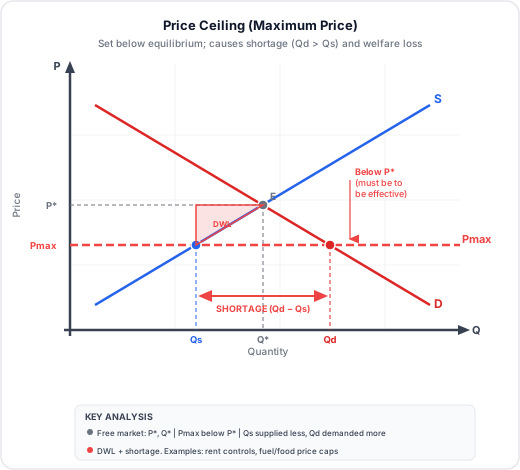
[Diagram: A standard supply and demand diagram showing equilibrium at P*, Q*. A horizontal line at Pmax (below P*) represents the price ceiling. At Pmax, quantity demanded is Qd (from the demand curve) and quantity supplied is Qs (from the supply curve), with Qd > Qs, creating a shortage of (Qd - Qs). The deadweight loss appears as a triangle between the demand and supply curves, bounded by Pmax and the shortage range.] The imposition of a maximum price Pmax below equilibrium causes quantity supplied to fall from Q* to Qs, while quantity demanded increases to Qd. The shortage (Qd - Qs) represents unsatisfied demand. Deadweight loss arises because mutually beneficial trades between willing buyers (with valuations between Pmax and P*) and willing sellers (with costs between Pmax and P*) cannot occur due to the legal price constraint. Consumer surplus changes: consumers pay less but face rationing costs and reduced availability. Producer surplus falls significantly due to lower price and reduced output. The net welfare effect is typically negative because deadweight loss from foregone trades exceeds consumer gains from price reduction.
The magnitude of shortage and deadweight loss depends on elasticities of supply and demand. Inelastic supply (e.g., housing with fixed stock in short run) creates large shortages; elastic supply (e.g., services that can scale) creates smaller shortages. Similarly, inelastic demand (e.g., essential medicines) means consumers remain willing to buy despite shortages, exacerbating rationing difficulties. The elasticity of demand also determines consumer surplus changes: consumers of goods with inelastic demand benefit more from price reductions but face severe shortages, whilst elastic demand goods face less acute shortages but smaller consumer benefits from the price ceiling.
Maximum prices create significant negative unintended consequences. First, black markets emerge: at shortage conditions, some buyers are willing to pay above Pmax. Sellers operating illegally can capture this willingness to pay, creating underground markets. UK housing shortages have fuelled informal lettings and subletting at above-ceiling prices, undermining the policy goal and creating legal/safety issues. Second, quality deterioration occurs as producers minimize costs. Landlords reduce maintenance; energy companies reduce customer service; pharmaceutical companies reduce R&D for price-capped medicines. Consumers receive lower-quality goods, partially offsetting the price benefit. Third, supply reduction: in long run, producer profits fall below normal rates, causing firms to exit or cease investment. UK energy market consolidation and housing supply stagnation exemplify this.
Alternative policies may be more efficient. Subsidies (government pays part of price, consumers pay subsidized amount) reduce shortages whilst lowering consumer costs, avoiding supply-side disincentives if subsidies are sufficient to maintain profitability. Vouchers provide targeted support to vulnerable groups without suppressing overall price signals. Regulation of profitability (allowing reasonable returns) rather than absolute price caps balances affordability and supply incentives. Competition policy breaking up monopolies/oligopolies addresses root causes of high prices rather than capping symptoms. For essential goods with genuine market failure (information asymmetries, positive externalities), targeted interventions (education subsidies, healthcare vouchers) may better balance equity and efficiency than broad price ceilings. Short-run price controls may temporarily protect consumers during crises, but long-run alternatives avoid supply-side deterioration and deadweight loss.
Student Response
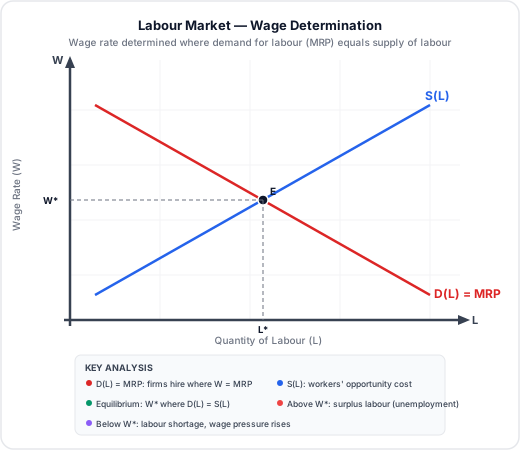
In a competitive labour market, wage rates are determined by the interaction of labour demand and labour supply. Labour demand is derived demand: firms demand labour not for its intrinsic value but because labour produces output that firms can sell. The marginal revenue product of labour (MRPL) represents the additional revenue a firm gains from employing one more worker. MRPL = Marginal Physical Product (MPP, additional output from one more worker) × Marginal Revenue (MR, revenue from selling one additional unit of output). A firm maximizes profit by employing labour until MRPL equals the wage rate: MRPL = W. Thus, the firm's demand for labour is its MRPL curve (downward-sloping due to diminishing returns: each additional worker adds less output than the previous). At equilibrium in a competitive market, W = MRPL because all firms face identical wage rates.
Labour supply reflects workers' willingness to supply labour at different wage rates. The opportunity cost of working is leisure forgone; as wages rise, leisure becomes more expensive, incentivizing work (substitution effect outweighs income effect for most workers, creating upward-sloping labour supply). In a competitive market with many workers, individual workers are wage-takers, accepting the market wage. The market equilibrium wage W* occurs where aggregate labour demand (summed MRPL curves of all firms) equals aggregate labour supply. At W*, quantity of labour demanded equals quantity supplied; there is neither unemployment nor labour shortage. Regional wages, skill premiums, and wage variations reflect differences in labour demand (due to sectoral productivity, capital intensity) and labour supply (differences in skill acquisition, location preferences).
UK labour market data illustrate these principles. In 2024, the National Minimum Wage (NMW) was £11.44 per hour for workers aged 21+, whilst the National Living Wage (NLW) for workers 23+ was £11.44. However, market wages for skilled workers far exceed these floors: software engineers earn median £55,000-£70,000 annually due to high MRPL (their output generates substantial firm revenue), whilst care workers earn £20,000-£24,000 annually, reflecting lower MRPL in less capital-intensive sectors. Regional wage disparities reflect differences in labour demand: London median wage (£33,000 in 2024) exceeds regional averages (£28,000 in Midlands) due to concentration of high-productivity industries (finance, tech). The NHS illustrates labour supply constraints: nurse shortages persist despite wage increases to £27,000-£32,000 annually because the UK's restricted training capacity limits labour supply relative to demand. International competition (emigration to countries offering higher wages) further constrains supply of skilled workers.
The NLW's introduction (£7.20 in 2016, rising to £11.44 by 2024) created a wage floor above the competitive equilibrium for low-skilled workers in some sectors, generating employment effects: youth unemployment did not rise substantially, but hours per worker fell in some sectors, and some employers substituted capital for labour or reduced non-wage benefits (training, flexible scheduling). Data suggest the NLW impacts approximately 2-3% of workers, with larger effects in rural areas and sectors with lower productivity (hospitality, retail). Trade union membership, declined in UK (from 40% in 1975 to 23% in 2024), reduces collective wage bargaining power; remaining unionised sectors (public sector, utilities) achieve wage premiums of 5-15% relative to non-unionised equivalents.
[Diagram: A standard labour market diagram with quantity of labour (L) on x-axis and wage (W) on y-axis. The labour supply curve (SL) slopes upward, reflecting higher quantity supplied as wages rise. The labour demand curve (DL), representing the aggregate MRPL curve, slopes downward due to diminishing returns. They intersect at equilibrium point E, determining equilibrium wage W* and employment quantity L*. Shifts in demand (e.g., technological advancement increasing MRPL) or supply (e.g., immigration increasing labour supply) are shown to alter equilibrium outcomes.] At equilibrium, wage W* and employment L* are determined. If wages rise above W*, excess supply (unemployment) results: workers willing to work at lower wages undercut the higher rate, pushing wages down. If wages fall below W*, excess demand (labour shortage) results: firms competing for scarce workers bid wages up. The flexibility of wage adjustment maintains equilibrium in competitive markets without persistent unemployment or shortages.
The elasticity of labour demand varies by sector and skill level. Sectors with high capital intensity and high product demand elasticity (manufacturing, services in competitive markets) have elastic labour demand: wage increases cause substantial employment reductions. Sectors with inelastic labour demand (public sector, regulated utilities) see smaller employment effects from wage changes. Skilled labour demand is more inelastic when skills are scarce and difficult to substitute (e.g., cardiac surgeons); their wages rise substantially without proportional employment loss. Comparative advantages in labour supply further segmenting wages: workers acquiring scarce skills (engineering, medicine) command wage premiums because their MRPL is higher and labour supply is restricted by educational barriers.
However, real labour markets deviate from perfect competition. Monopsony power: employers in concentrated labour markets (single large employer in a small town) face upward-sloping labour supply curves and set wages below MRPL, exploiting workers' limited outside options. Public sector employers and some large corporates in regional areas exercise this power. Trade unions create countervailing power, negotiating collectively to raise wages above competitive levels (e.g., 8-10% union wage premium in UK public sector). These reduce efficiency but redistribute income toward workers. Government intervention (NLW, employment protections) restricts wage-setting flexibility; whilst raising floor wages protects vulnerable workers, it creates unemployment risk for least-productive workers (youth, low-skilled) when wages exceed their MRPL.
Imperfect information distorts wage determination: workers may lack knowledge of alternative employment opportunities, reducing mobility and wage bargaining power. Firms may possess private information about productivity gains, potentially underpaying workers. Non-monetary benefits (pension contributions, flexible working) complicate wage comparisons; total compensation often exceeds nominal wages. Human capital investments (education, training) create wage premiums by increasing MRPL; the relationship between education and earnings is strong (graduates earn 40-50% more than non-graduates in UK), supporting the productivity-based wage determination model. However, signalling value (degree as job market signal rather than pure productivity enhancement) complicates interpretation. In conclusion, competitive labour market theory explains wage determination through MRPL and supply/demand, but real markets exhibit monopsony power, imperfect information, and institutional friction, requiring nuanced policy balancing efficiency, equity, and worker protection.
Student Response
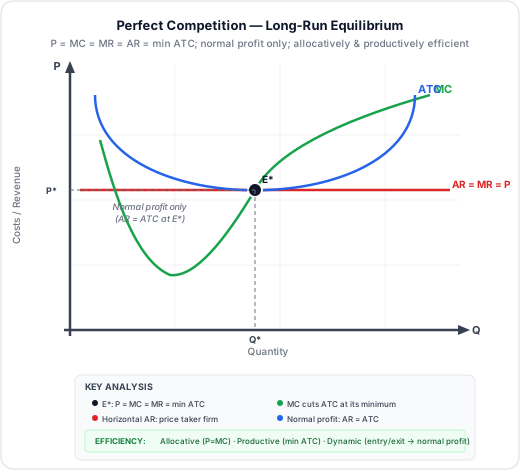
Perfect competition is a theoretical market structure with five key assumptions: (1) many small firms and buyers, none able to influence price; (2) homogeneous products with no differentiation; (3) perfect information available costlessly to all market participants; (4) free entry and exit with no barriers; (5) rational economic actors maximizing profit. Under these conditions, firms are price-takers, facing a perfectly elastic demand curve at the market price. In the short run, firms maximize profit where Price = Marginal Cost (P = MC), earning potentially abnormal profits if price exceeds average total cost (ATC). In the long run, free entry/exit drives abnormal profits to zero: new firms enter until price falls to the minimum point of the ATC curve. Long-run equilibrium occurs where P = MC = minimum ATC, and firms earn only normal (zero economic) profit. This outcome satisfies both allocative efficiency (P = MC: the marginal benefit to society equals marginal cost, no under/overproduction) and productive efficiency (firms operate at minimum ATC: lowest possible cost, no waste).
Allocative efficiency means society's resources are allocated to their highest-value uses: the quantity produced at which willingness to pay (demand price) equals production cost (marginal cost) maximizes total surplus. Productive efficiency means firms produce at minimum average cost, eliminating X-inefficiency (production waste). Together, they represent Pareto efficiency: no reallocation can benefit someone without harming another. Perfect competition achieves both in long-run equilibrium, suggesting optimal resource allocation without waste. This forms the theoretical ideal against which real markets are evaluated, underpinning the case for free markets and competition policy.
Markets approaching perfect competition characteristics exist in developed economies, notably agriculture and commodity markets. Wheat farming in the UK exhibits many competitive features: thousands of small farms, homogeneous product, price-takers accepting market prices, free entry/exit (though with high capital requirements), and transparent pricing via futures markets. A farmer cannot influence wheat prices by changing output; individual supply is perfectly elastic to farm-level decisions. Similarly, foreign exchange markets approach perfect competition: billions of transactions daily, homogeneous currency units, many traders (banks, corporations, speculators), transparent pricing, and zero barriers to trading. Participants are price-takers; large dealers face competition preventing price manipulation beyond transaction spreads.
However, pure perfect competition is rare because assumptions are violated in practice. UK agriculture involves government subsidies (Common Agricultural Policy transition), import tariffs, and regional concentration affecting competition. Foreign exchange trading features information asymmetries and central bank intervention (not costless information). Most real markets have product differentiation (even standardized goods like petrol vary by convenience store location and brand), information gaps (consumers don't know all alternatives), and barriers (capital requirements, licensing). Retail banking, aviation, and telecommunications maintain significant market concentration despite liberalization. Agricultural markets, whilst approximately competitive, experience price volatility from weather, trade policy, and input cost shocks that perfect information and homogeneity would mitigate. These deviations mean real markets achieve neither perfect allocative nor productive efficiency.
[Diagram: A long-run equilibrium diagram for a perfectly competitive firm showing demand (D = MR = AR), marginal cost (MC), and average total cost (ATC) curves. The MC curve intersects demand at point E, determining equilibrium output q*. At this output, ATC is at its minimum point, tangent to the demand curve. Price (P*) equals MC equals minimum ATC, with normal profit (zero economic profit) earned. A separate market diagram shows aggregate demand and supply curves determining market price P*, which individual firms take as given.] At long-run equilibrium, each firm produces output q* where P = MC = minimum ATC. Consumer surplus (area between demand curve and price) and producer surplus (area between price and supply curve) are maximized; deadweight loss is zero. The allocation is allocatively efficient because P = MC: the value consumers place on the marginal unit (P) equals its production cost (MC), meaning no beneficial trades are foregone. Productive efficiency holds because firms operate at minimum ATC: lower output per firm or higher-cost production would violate profit-maximization, given free entry competition.
The dynamism of perfect competition also contributes to efficiency: entry/exit of firms adjusts supply to changing demand without government intervention. If demand rises, prices rise above ATC, attracting new entrants until supply increases, prices fall, and equilibrium is restored. This self-correcting mechanism efficiently allocates resources over time. The benchmark of perfect competition efficiency provides a yardstick: monopolies create deadweight loss by restricting output (P > MC); monopolistic competition leaves excess capacity (P > minimum ATC); information asymmetries create market failures. Perfect competition eliminates these inefficiencies through decentralized price signals requiring no central planning or regulation.
However, perfect competition's efficiency claim has critical limitations. First, dynamic efficiency (innovation and technological progress) is absent: in perfect competition, normal profit leaves no funds for R&D. Firms operating at zero economic profit cannot afford substantial innovation investment; new ideas emerge from entrepreneurs earning supernormal profits (monopoly/monopolistic competition), not perfectly competitive firms. Pharmaceutical innovation, software development, and consumer electronics advancement have occurred under imperfect competition (patent monopolies, first-mover advantages) where firms capture R&D returns through temporary market power. Perfect competition would deter such innovation, reducing long-run consumer welfare despite static efficiency gains.
Second, perfect competition's assumptions are empirically unrealistic and unattainable. Perfect information is impossible: acquiring and processing all market information incurs positive costs (search costs, professional advice). Homogeneous products are rare; differentiation reflects consumer preferences for variety and firms' incentives to compete on quality. Free entry faces real barriers: capital requirements (farming requires land/equipment worth £500,000+), licensing (professional services, utilities), intellectual property, and network effects (telecommunications, social media). These are often efficient barriers reflecting real resource constraints or positive externalities. Attempts to enforce perfect competition through antitrust (breaking up large firms, preventing mergers) may destroy economies of scale, raising average costs and harming consumers. Second-best theory (Lipsey-Lancaster) shows that when one condition for perfect competition fails, forcing others may reduce, not improve, efficiency. For instance, breaking up a natural monopoly with declining ATC increases average costs, reducing welfare despite achieving perfect competition's structural form.
Third, perfect competition ignores distribution: allocative efficiency maximizes total surplus but doesn't specify fairness. A highly unequal income distribution achieves allocative efficiency where demand reflects willingness and ability to pay; perfect competition is indifferent to distributional outcomes. Monopolistic competition, whilst less allocatively efficient (P > MC), provides product variety valued by consumers and covers fixed costs through differentiation premiums, potentially improving real-world welfare. In conclusion, perfect competition achieves static allocative and productive efficiency under its assumptions, but perfect competition itself is unattainable, dynamic efficiency requires imperfect competition, and second-best considerations suggest imperfect competition may sometimes improve overall welfare. Rather than viewing perfect competition as an absolute ideal, it serves as a benchmark for evaluating real markets; regulatory policy should balance static efficiency with dynamic innovation, distributional concerns, and realistic constraints rather than pursuing impossible perfect competition.
Student Response
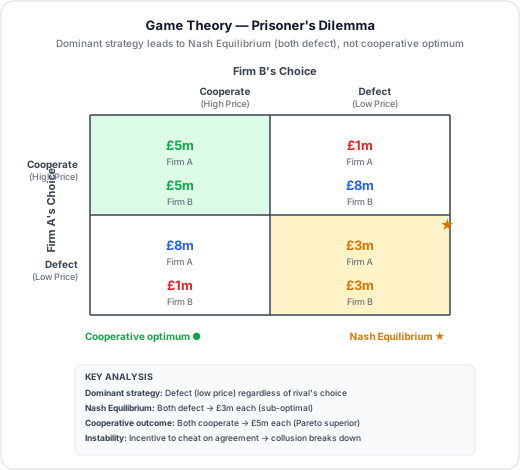
An oligopoly is a market structure with few large interdependent firms producing homogeneous or differentiated products. Interdependence is crucial: each firm's profit depends not only on its own actions but also on rivals' responses. Game theory provides a framework for analysing strategic interactions in such settings. A game comprises players (firms), strategies (choices available to each), and payoffs (profits resulting from strategy combinations). A payoff matrix displays potential outcomes for each strategy combination. The Nash equilibrium is a strategy combination where no player can improve their payoff by unilaterally deviating, given others' strategies. A dominant strategy is one that yields the highest payoff regardless of opponents' actions. The prisoner's dilemma illustrates why rational self-interest can produce collectively suboptimal outcomes: both players prefer mutual cooperation to mutual defection, yet each individually benefits from defection, leading to a Nash equilibrium worse than cooperation.
In oligopoly, firms may collude (explicitly or tacitly) to restrict output and raise prices above competitive levels, earning joint monopoly profits. However, each individual firm faces an incentive to defect: by slightly undercutting the agreed price (or exceeding the output quota), a firm can capture rivals' customers, dramatically increasing its own profit if competitors maintain the agreement. This creates a prisoner's dilemma: the cooperative outcome (monopoly pricing) is collectively preferred, but the defective outcome (competitive pricing) is the Nash equilibrium because each firm rationally defects. Formal cartels (explicit price/output agreements) address this through binding contracts, but these are illegal in most jurisdictions. Without legal enforcement, cartels are unstable.
UK supermarkets (Tesco, Sainsbury's, Asda, Morrisons) operate as an oligopoly with periodic price wars illustrating the prisoner's dilemma. In 2023-2024, intense competition on fuel prices and grocery items led all major chains to reduce margins below monopoly-profit levels. When one chain (e.g., Sainsbury's-Asda attempted merger blocked by CMA in 2019) offers "price match" guarantees, others feel compelled to follow to avoid losing customers, driving prices toward marginal cost. This competitive outcome harms individual retailers (lower margins) compared to implicit cooperation, yet each rationally defects because pricing above competitors risks losing market share. UK airlines (British Airways, easyJet, Ryanair) similarly engage in pricing competition; despite potential coordination on high-margin routes, price competition is intense because cost structures and demand elasticity vary, making cooperation difficult and defection individually rational.
Mobile networks (EE, Vodafone, O2) attempted industry coordination in 2010s spectrum auctions, but competition subsequently intensified; one firm undercutting triggers price wars across all competitors. OPEC oil cartel attempted production quotas to support crude prices, but member nations frequently exceed quotas (cheating) because each nation's profit rises from higher output if others maintain restrictions. Saudi Arabia and Russia particularly fail to coordinate, as marginal production costs are low, making quota-busting individually rational. The Competition and Markets Authority actively investigates suspected cartels; in 2023, investigations into construction materials price-fixing and financial services collusion illustrate how competitive pressure eventually causes cartels to unravel, with defectors competing aggressively once collusion breaks.
[Payoff Matrix: A 2x2 matrix with two firms (A and B), each choosing between "Cooperate (high price)" and "Defect (low price)". Payoffs in each cell represent profits: (1) Both cooperate: each earns £100m; (2) A cooperates, B defects: A earns £50m, B earns £150m; (3) A defects, B cooperates: A earns £150m, B earns £50m; (4) Both defect: each earns £80m.] Firm A's dominant strategy is to defect: if B cooperates, A earns £150m (defect) vs £100m (cooperate); if B defects, A earns £80m (defect) vs £50m (cooperate). Defection is best regardless of B's choice. By identical logic, B also defects. The Nash equilibrium is mutual defection (both earn £80m), despite the cooperative outcome (both £100m) being superior. This explains oligopolistic competition: firms rationally choose defection, resulting in less collusion and more competition than cartel arrangements would permit.
The credibility of cooperation depends on firms' ability to detect and punish defection. If monitoring is imperfect (difficult to observe rivals' true prices due to secret discounts, bundling, or complex contracts), defection goes unpunished, destabilizing cooperation. If punishment (price wars, market share retaliation) is credible and sufficiently severe, repeated games can sustain cooperation: a firm considers long-term profit from sustained cooperation against short-term gain from defection, making cooperation rational if the discount rate is low (firms value future profits highly) and punishment is swift. Kinked demand theory represents one model of tacit (unspoken) cooperation: firms implicitly accept a common price, with stronger price competition below it (if one defects, triggering all-out price war) than above it (firms don't match price increases, fearing volume loss). The kink represents the implicit threat that defection triggers punishment.
Firms can overcome prisoner's dilemma constraints through repeated game effects: if oligopolists interact repeatedly and expect continued interaction, cooperation can be sustained via trigger strategies (e.g., "maintain high price as long as rivals do; defect if any rival defects, competing aggressively thereafter"). UK supermarkets implicitly maintain price levels on premium products (lower elasticity demand) whilst aggressively competing on loss-leader basics; this reflects tacit coordination on less-price-sensitive categories and competitive pressure on price-sensitive ones. However, such coordination is fragile: if a firm enters with a disruptive model (Aldi, Lidl entering UK grocery market with low-cost strategy, or Ryanair entering aviation with ultra-low-cost model), established coordination collapses because the newcomer has different incentives and cost structures.
Legal structures matter critically: explicit written cartels are illegal in UK/EU competition law, prosecuted by the CMA. Managers convicted of cartel conduct face personal fines and imprisonment (up to 5 years in UK), creating strong deterrents. Tacit coordination (parallel pricing without explicit agreement) is difficult to prosecute because proving collusion requires evidence of coordination; parallel behaviour alone is insufficient if each firm independently adopts the same strategy. This legal asymmetry between explicit and implicit collusion affects oligopolistic outcomes: formal cartels are eliminated, but tacit cooperation persists in concentrated markets with transparent pricing and homogeneous products (airlines, supermarkets). International differences in cartel enforcement (USA, EU stricter than some developing economies) also affect coordination: multinational firms may coordinate more easily across lenient jurisdictions.
In conclusion, game theory reveals that oligopolistic firms rationally defect from cooperation because defection is a dominant strategy: individual incentives diverge from collective interests, producing the Nash equilibrium of competitive pricing rather than monopoly outcomes. Explicit cartels address this through binding agreements but are illegal. Repeated games with credible punishment (trigger strategies) can sustain tacit cooperation, explaining partial coordination in some markets. However, coordination remains unstable due to incentives to cheat, new entrants with different cost structures, imperfect monitoring, and legal prohibitions on explicit collusion. The result is oligopolistic competition between the perfectly competitive and monopolistic extremes: prices above marginal cost (some market power remains) but below monopoly levels (competition prevents full exploitation). Market concentration, transparency, homogeneity of products, and barriers to entry enable more coordination; conversely, product differentiation, cost heterogeneity, frequent entry, and enforcement scrutiny reduce it. Regulators exploit prisoners' dilemma dynamics by offering leniency programs: the first cartel member to confess escapes prosecution, incentivizing defection and cartel breakdown. This demonstrates how understanding game theory strategically undermines anticompetitive coordination.
Student Response
A monopoly is a market with a single seller of a product with no close substitutes, protected by high barriers to entry (economies of scale, legal barriers, control of essential resources). In the short run, monopolies earn abnormal (supernormal) profits; in the long run, barriers prevent entry, so supernormal profits persist. Monopolistic competition comprises many firms selling differentiated products with relatively low barriers to entry. Firms have some price-setting power due to product differentiation (brand loyalty, quality perception), facing downward-sloping demand curves. However, free entry/exit drives long-run profit to normal levels: if supernormal profit emerges, new entrants are attracted; increased competition reduces individual firms' demand until profit normalizes. Key differences: monopolies have near-absolute price-setting power; monopolistically competitive firms have limited power due to substitutes. Monopolies earn persistent supernormal profit; MC firms earn normal profit long-run. Monopolies restrict output (P > MC); MC firms also charge above MC but with less restriction. Monopolies have little incentive to innovate; MC firms innovate to differentiate products and sustain profit temporarily.
Both structures result in allocative inefficiency compared to perfect competition (P > MC at equilibrium), creating deadweight loss. However, monopolistic competition operates with lower barriers and free entry, limiting market power. Productive efficiency also differs: monopolies may achieve scale economies (lower average cost through large output); monopolistically competitive firms typically operate at less than minimum ATC due to excess capacity (lower output per firm, higher average cost due to duplication of advertising, brand-building). The welfare comparison is ambiguous: monopolies may offer dynamic efficiency (innovation from supernormal profits) at the cost of static inefficiency; monopolistically competitive markets offer product variety and freedom of entry but with productive inefficiency.
UK monopolies include Thames Water (water supply in South East), a natural monopoly regulated by Ofwat. High fixed costs (infrastructure) make single provision most efficient; breaking it up would increase costs. Thames Water supplies approximately 15 million customers; duplicating distribution networks would triple costs, ultimately raising consumer bills. However, as an uncompetitive supplier, Thames Water has faced criticism for high prices (bills increased 26% 2020-2024), poor service (water pressure failures in summer 2023), and slow investment in leakage reduction (currently 29% of supply lost to leaks). Its monopoly position insulates it from competitive pressure to improve. BT Openreach controls most UK copper telephone lines; its near-monopoly (particularly in rural areas where alternatives are prohibitively expensive) enables high prices and slow rollout of superfast broadband in unprofitable regions, discussed by Ofcom as a potential market failure requiring intervention.
Monopolistic competition typifies restaurants, hairdressers, and clothing retail. London has thousands of restaurants, each differentiated by cuisine (Italian, Thai, Indian), location, price, and reputation, with relatively low barriers to entry (can open a restaurant with modest capital, training, and business skills). Profitability is temporary: successful restaurants attract imitators; less successful ones exit. Consumer benefits from choice: can find cuisine matching preferences, price points varying from £5 takeaway to £100+ fine dining, quality/convenience mixes. Hairdressers similarly compete on location, stylist reputation, price, and ambiance; multiple styles (cheap/quick cuts vs premium salons) coexist. Clothing retail features brands like Zara, H&M, Topshop, Uniqlo, each differentiated by style/price positioning, with entry possible via online-only models (Boohoo, Asos). Consumers benefit from variety; whilst all sell above marginal cost (like monopolies), the competitive entry prevents excessive markups and drives innovation in design and supply chain efficiency.
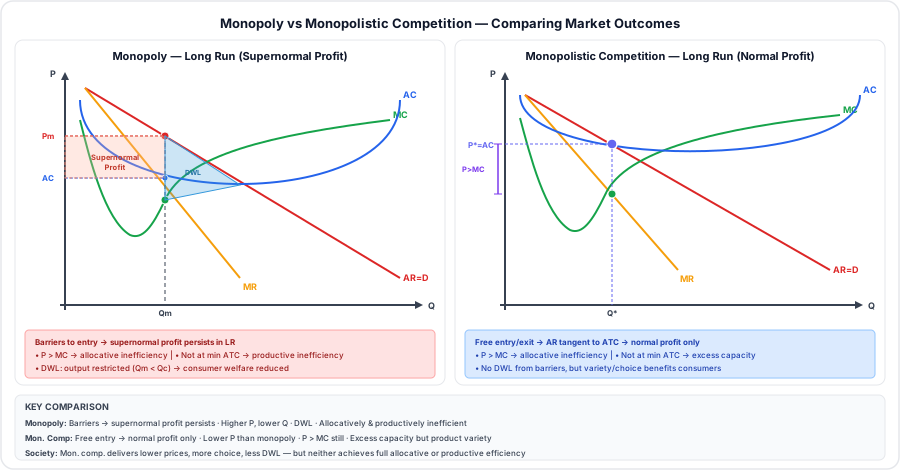
[Diagram A (Monopoly Long-Run Equilibrium): Demand (D), Marginal Revenue (MR), and Marginal Cost (MC) curves. The monopoly sets output Qm where MR = MC, charging Pm from the demand curve. Average Total Cost (ATC) is below price, yielding supernormal profit (shaded area above ATC up to Pm). Deadweight loss is the triangle between demand, MC, and the quantity not produced due to output restriction.] [Diagram B (Monopolistic Competition Long-Run Equilibrium): Demand curve tangent to ATC curve at output Qmc; price Pmc equals ATC, yielding normal (zero economic) profit. The demand curve is less steep than monopoly's (more elastic due to substitute products), and output Qmc is larger and price lower than monopoly, but the firm operates at ATC not at minimum ATC, indicating excess capacity. Deadweight loss is smaller than monopoly but still positive because Pmc > MC.]
Comparing outcomes: Monopoly (Pm, Qm) vs. Monopolistic Competition (Pmc, Qmc) shows Pm > Pmc (monopoly price higher) and Qm < Qmc (monopoly output lower). Monopolistic competition gets closer to competitive pricing/output, reducing deadweight loss. However, monopolistic competition exhibits productive inefficiency: firms operate at Pmc = ATC (tangency), but ATC is above minimum ATC. If a firm produced at minimum ATC, lower output would mean higher average cost, reducing profit; thus free entry drives inefficient scale. Monopoly may achieve minimum ATC (producing large output at low average cost) if scale economies are significant, offsetting allocative inefficiency. Consumer surplus is higher in MC due to lower prices and greater quantity, despite productive inefficiency. The comparison of total welfare (consumer + producer surplus minus deadweight loss + productive inefficiency loss) depends on the relative magnitudes: large scale economies in monopoly may offset static inefficiency, or MC's variety and low barriers may dominate.
Monopolies' potential benefits to consumers include dynamic efficiency and scale economies. Pharmaceutical monopolies funded by patent protection (10-20 years typically) invest billions in drug development: Gilead, Roche, AstraZeneca spend 15-20% of revenue on R&D, discovering life-saving treatments (cancer immunotherapy, COVID vaccines developed rapidly partly due to profit incentives). Without patent monopolies, private R&D would collapse, and many drugs would not emerge (no firm would bear development costs if competitors immediately copied). Scale economies in infrastructure (water, electricity, railways) mean monopoly is technically efficient: one supplier serving large area minimizes average cost. Splitting these sectors would raise costs and harm consumers through higher prices. Thus, in innovative and capital-intensive sectors, monopoly can benefit consumers through innovation and scale efficiency despite static allocative inefficiency.
Monopolistic competition's benefits include product variety and consumer choice. Each firm's differentiation reflects consumer preferences for variety in style, quality, convenience, and price; perfect competition offers one homogeneous product, whilst MC offers choices tailored to different preferences. Choice itself is valuable: a hairdresser preferring creative, fashion-forward styling benefits from high-end salons; price-conscious customers benefit from budget options; both are available under MC, absent under perfect competition's homogeneity. Free entry attracts new competitors, limiting monopoly power; unsuccessful firms exit, forcing survivors to innovate and improve efficiency to remain profitable. This competitive pressure is absent in monopolies protected by barriers. However, MC's productive inefficiency (excess capacity) is a real cost: resources are wasted on sub-minimum-scale operations; a consolidated structure (fewer firms at larger scale) would lower average costs and prices, benefiting consumers. Additionally, product differentiation sometimes reflects wasteful advertising rather than genuine quality differences, creating social cost without benefit.
The question "which benefits consumers more" is context-dependent rather than universal. In innovative, capital-intensive sectors with high barriers (pharmaceuticals, utilities, telecoms infrastructure), monopoly with regulation offers superior outcomes: R&D investment and economies of scale benefit consumers more than the static inefficiency costs. Ofwat, Ofgem, and Ofcom regulate natural monopolies, imposing price caps, quality standards, and investment requirements balancing monopoly benefits with consumer protection. In sectors with low barriers, frequent innovation, and heterogeneous consumer preferences (restaurants, clothing, services), monopolistic competition is superior: choice, variety, and competitive entry pressure outweigh productive inefficiency. Most modern economies adopt this hybrid approach: competition policy breaks up artificial monopolies, preserves natural monopolies under regulation, and permits monopolistic competition in contestable markets. Rather than monopoly or MC uniformly dominating, optimal market structure varies by sector, technological factors, and consumer preferences, requiring nuanced regulation rather than blanket prescriptions.
Student Response
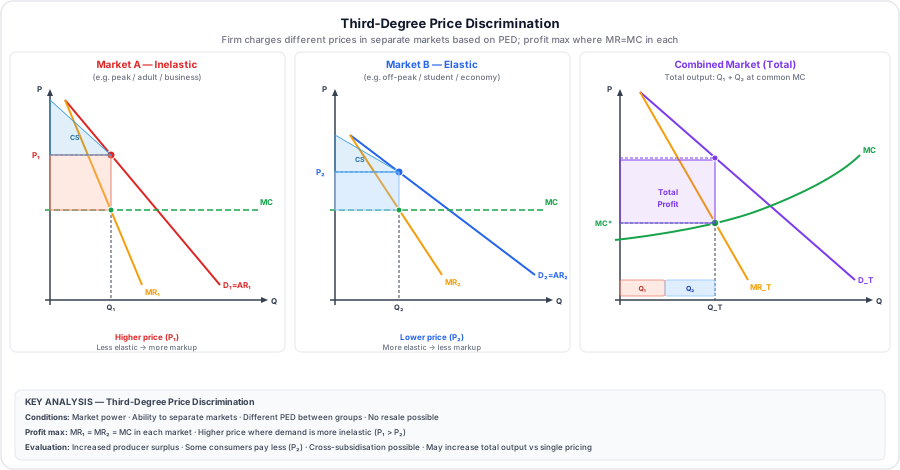
Price discrimination occurs when a firm charges different prices to different consumer groups for the same product (or versions differing only in packaging/delivery), reflecting differences in ability or willingness to pay rather than differences in production cost. Three degrees of price discrimination exist: (1) First-degree: the firm charges each consumer their reservation price (maximum willingness to pay), extracting all consumer surplus as profit. This requires perfect information about individual preferences and prevention of resale; it is rarely observed outside personalised services (auction bidding, professional fees negotiated individually). (2) Second-degree: the firm offers different versions or quantities at different prices (bulk discounts, quality tiers), allowing consumers to self-select based on preferences. Block pricing (e.g., utilities: lower rate per unit for higher consumption) exemplifies second-degree. (3) Third-degree: the firm divides market into segments (age, location, income) and charges different prices to each, determined by price elasticity of demand (PED) in each segment. Most price discrimination observed is third-degree (peak/off-peak pricing, student discounts).
For price discrimination to work, firms require: (1) Market power: ability to set price above marginal cost (perfect competition prevents PD because price is set by market forces). (2) Ability to segment markets: identify which consumers have high vs low PED and separate them (geographic, demographic, timing-based, or self-selection mechanisms). (3) Prevention of arbitrage/resale: if price-sensitive customers can resell to high-price segments, segmentation breaks down. Firms using PD maximize profit by setting price lower (closer to MC) in elastic segments (price-sensitive) and higher in inelastic segments (price-insensitive). This increases total quantity sold (elastic segment sales increase significantly from lower price) and total revenue compared to uniform pricing, potentially benefiting some consumers through lower prices whilst extracting maximum profit.
UK train operators employ extensive third-degree price discrimination. A London-Manchester ticket costs £15-20 if booked advance (high PED: price-sensitive leisure travellers), versus £80-150 for peak travel (low PED: business travellers with urgent, inelastic demand). Virgin Trains and TransPennine Express segment by time-of-travel and advance-purchase, maximizing revenue. Elderly and disabled passengers access concessionary fares (30-50% reductions), reflecting lower PED or equity concerns. Off-peak discounts for students reflect demographics. This enables operators to serve price-sensitive segments (reduced ticket prices expand market size) whilst extracting high fares from business users with urgent, inelastic demand. Without PD (uniform pricing), they would charge medium price, losing elastic leisure travellers to cars and coaches or losing revenue from inelastic business segment.
Cinemas charge students/OAPs £7-8 vs full price £11-13, reflecting lower willingness to pay. Airlines charge business passengers £600-1000 return London-Paris (low PED: non-negotiable business travel) vs leisure £80-150 advance booking (high PED: flexible, price-sensitive tourism). Supermarkets use loyalty cards enabling targeted discounting: Tesco offers personalised discounts based on past purchases, charging price-sensitive categories discounts whilst maintaining higher prices on premium/convenience goods. Pharmaceutical pricing varies by country: UK NHS negotiates low prices (monopsony power, price sensitivity); USA drugs cost 2-3x higher due to lower price elasticity (insurance absorbs cost, patients less price-sensitive). These examples show PD ubiquity in modern markets.
[Diagram: Two market segments (e.g., Business and Leisure) side by side. Each has demand curve (Dbusiness steeper/inelastic, Dleisure flatter/elastic), with the same MC horizontal line. The firm sets price where MR = MC in each segment. Pbusiness is high, Qbusiness is low; Pleisure is low, Qleisure is high. Total quantity (Qbusiness + Qleisure) exceeds what a uniform-price monopoly would produce, approaching competitive output levels.] Third-degree PD operates by setting price (based on PED) such that MR in each segment equals the same MC. In the elastic (Leisure) segment with flatter demand, lower prices yield higher quantity (elastic: price reduction increases revenue). In the inelastic (Business) segment with steep demand, higher prices yield lower quantity. The equilibrium satisfies MR_business = MR_leisure = MC, but prices differ (P_business > P_leisure). Total output often exceeds uniform monopoly output because the price cut in elastic segments stimulates quantity sold there by more than the price rise reduces quantity in inelastic segments. This increased output reduces deadweight loss: total welfare (consumer plus producer surplus) improves relative to uniform monopoly pricing.
The welfare effect depends on two factors: (1) Output effect: if PD increases total output (common when elasticities differ substantially), deadweight loss decreases, benefiting consumers in aggregate (though distribution matters). (2) Extraction effect: even with higher output, PD allows the monopolist to extract more consumer surplus from inelastic segments, potentially harming those consumers. For example, business travellers on peak trains pay far more (extraction), whilst leisure travellers benefit from discounts (expansion of their segment). Cross-subsidisation can occur: profitable high-price segments (business, full-price) fund loss-making low-price segments (students, off-peak), enabling provision that might otherwise be unprofitable. UK rail cross-subsidisation ensures rural/less-dense routes remain viable; cinemas' student discounts rely on full-price paying adults subsidising them.
Price discrimination benefits some consumers and harms others. Benefits: (1) Lower prices in elastic segments: budget airline fares (Ryanair £30 advance) vs legacy carriers (BA £300 peak) expanded air travel, benefiting price-sensitive leisure passengers. Student/OAP cinema discounts enable lower-income groups to consume cultural goods. (2) Increased output: the volume of air travel, train journeys, and cinema visits increased due to lower-price options attracting elastic consumers. (3) Cross-subsidisation: enables unprofitable services to persist (rural train routes, niche cinemas showing independent films). (4) Market expansion: without PD (forced uniform pricing), many elastic-demand consumers would not purchase, narrowing markets. Harms: (1) Price exploitation: business travellers pay high rail fares (often corporate-covered, but reflecting economic costs); pharmaceutical patients in low-income countries cannot afford high prices charged in high-income nations, raising equity concerns. (2) Complexity and information asymmetries: consumers struggling to identify lowest prices (dynamic airline pricing, hidden loyalty card benefits) disadvantage less-informed shoppers. (3) Potential abuse: if firms discriminate based on protected characteristics (race, gender, disability, though illegal), fairness and dignity concerns arise.
Whether PD benefits or harms consumers depends on context and values. Economic efficiency perspective: PD typically improves aggregate welfare (lower deadweight loss due to higher output) compared to uniform monopoly pricing. Consumer gains in elastic segments often exceed losses in inelastic segments; total surplus increases. From this view, PD benefits consumers on average. Distribution perspective: whilst aggregate welfare may improve, some consumers (inelastic, captive) pay substantially more; fairness concerns arise. Business travellers subsidising leisure travellers (or vice versa) raises questions about whether everyone should benefit equally. Regulation perspective: some PD is beneficial (student discounts, subsidised essentials for low-income), but predatory PD (exploiting geographic monopolies, information asymmetries) may warrant regulation. UK regulators distinguish: rail operators' PD is permitted (efficient, pro-competitive if combined with open-access); attempts at geographic PD by utilities (charging different prices by postcode based on willingness to pay unrelated to cost) are restricted as exploitative. Conclusion: PD benefits aggregate consumer welfare and efficiency by expanding consumption where price elasticity is high and reducing deadweight loss. However, distributional harms to price-inelastic consumers and equity concerns require regulation to prevent exploitation whilst preserving efficiency gains, through transparency (clear pricing), protection of vulnerable groups (accessibility discounts), and prevention of abusive discrimination (postcode-based exploitation).