A Level Macro Essays
Edexcel Economics A Level - 25 Mark Essays covering Theme 2 (The UK Economy) and Theme 4 (A Global Perspective)
AO Legend
About the Mark Scheme
These essays are marked out of 25 marks using the Edexcel A Level Economics rubric. Each paragraph in the model essays is colour-coded to show which Assessment Objective (AO) it addresses:
- AO1 (Blue) — Demonstrate knowledge and understanding of economic theories, models, and real-world examples
- AO2 (Green) — Apply economic knowledge and understanding to unfamiliar contexts and real-world scenarios
- AO3 (Gold) — Analyse economic issues and problems using appropriate economic concepts and theories
- AO4 (Purple) — Evaluate evidence and make reasoned judgements, considering multiple perspectives and limitations
Tip: Strong essays integrate all four AOs throughout. Use the textareas below to draft your own response, then compare it with the model answer to see how each AO contributes to a cohesive argument.
Your Response
Model Essay: Supply-Side Policies and Sustained Growth
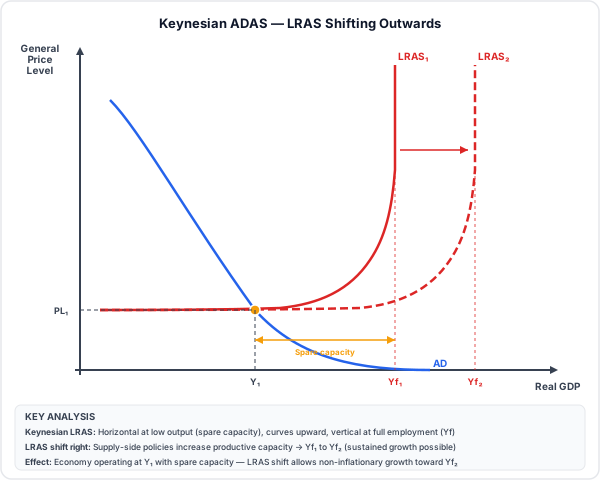
Sustained economic growth refers to a consistent long-term increase in real GDP per capita, typically maintained without inflationary pressure. This contrasts with actual growth (short-term fluctuations in output) and requires expansion of the productive potential of the economy, known as potential growth. The Long Run Aggregate Supply (LRAS) curve represents the economy's maximum output at full capacity. Supply-side policies are structural reforms that aim to shift the LRAS curve rightward by increasing productive efficiency, labour productivity, capital stock, and technological innovation. These include education and skills development, infrastructure investment, labour market deregulation, tax incentives for business investment, and research and development support.
In the UK context, the government has pursued significant supply-side reforms since 2010. George Osborne's strategy focused on apprenticeships (the Apprentice Levy), enterprise zones offering tax breaks in designated regions, reduction in corporation tax from 28% to 19%, and removal of employment regulation (e.g. reducing unfair dismissal claims). These aimed to boost productivity and capital investment. However, the UK's productivity growth has remained sluggish; according to the Office for National Statistics, UK productivity growth averaged just 0.5% annually post-2008, significantly below pre-crisis rates and compared to other G7 nations. Regional disparities have widened, with London and the South-East experiencing stronger growth than the Midlands and Northern regions, suggesting supply-side policies have not been uniformly effective across the economy.
Supply-side policies work by shifting the LRAS curve outward, enabling growth without necessarily increasing the price level in the short term. Education investment increases human capital and labour productivity; infrastructure spending reduces production costs and facilitates trade; business investment incentives boost capital stock and technological adoption. For example, improving transport infrastructure (HS2, road networks) reduces logistics costs for firms and enables faster commerce, shifting AS rightward. Deregulation of labour markets (reducing hiring costs, unfair dismissal legislation) makes it cheaper for businesses to employ workers, expanding labour supply. These mechanisms mean supply-side policies can deliver non-inflationary, sustainable growth, addressing the Phillips Curve trade-off that demand-side policies face.
However, supply-side policies operate within important constraints. Time lags are a critical limitation: education reforms take 15-20 years to pass through the workforce; infrastructure projects require years of construction and planning; business investment responds slowly to tax changes. The UK's productivity puzzle—wherein output grew post-2008 without corresponding capital or labour increases—suggests supply-side capacity exists but demand-side weakness constrains its realisation. If the economy operates with significant spare capacity (below potential output), supply-side shifts alone cannot boost actual growth; demand-side stimulus is necessary to reach the new LRAS level. Conversely, if the economy is at full capacity, demand-side increases would cause inflation without supply-side support.
The claim that supply-side policies are the most effective method for sustained growth is partially justified but incomplete. Supply-side policies are essential for potential growth and provide non-inflationary expansion, addressing a key weakness of demand-side policies. Yet they require demand-side support to be realised: a rightward LRAS shift has minimal impact if aggregate demand remains low. The post-2008 context illustrates this: despite supply-side reforms, the UK experienced weak growth (2009-2015), primarily because demand was depressed by austerity, bank deleveraging, and low consumer confidence. The state of the economy matters critically. In a demand-deficient recession, monetary expansion or fiscal stimulus may boost growth more quickly than supply-side reforms. In an economy near potential with inflationary pressures, supply-side policies are most appropriate. The effectiveness also depends on the type of growth prioritised: supply-side policies may increase overall output but not reduce inequality (indeed, labour deregulation may widen wage dispersion), raising equity trade-offs.
In conclusion, supply-side policies are vital for sustainable, non-inflationary growth but are not singularly the most effective method. A balanced approach is required: supply-side policies should form the long-term framework, expanding potential output through education, investment, and innovation. However, demand-side management (monetary and fiscal policy) remains necessary in the short term to ensure demand meets the expanding supply. The UK's experience suggests supply-side reforms alone—without accommodating demand—produce sluggish growth. Furthermore, policymakers must consider equity implications and ensure supply-side policies benefit the whole economy, not just financial centres. Therefore, the most effective approach combines credible supply-side reform with counter-cyclical demand management and regional redistribution, addressing both potential growth and actual growth simultaneously.
Your Response
Model Essay: Sterling Depreciation and UK Economic Impact
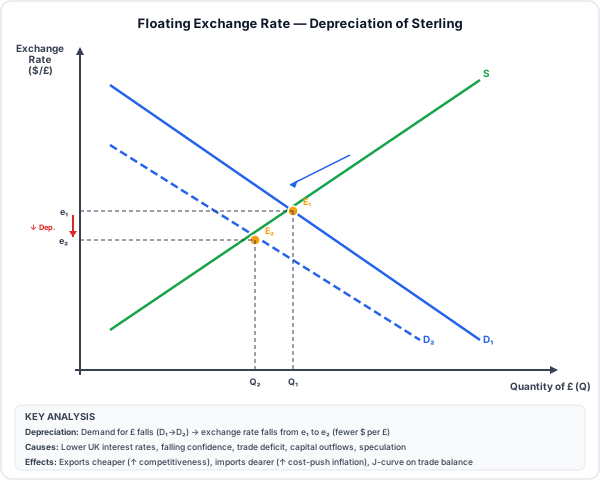
Exchange rate depreciation occurs when the value of a currency falls relative to other currencies, making exports cheaper and imports more expensive. The impact on the UK economy operates through several channels, best explained by the SPICED framework: Switch effect (exports become more competitive, shifting expenditure toward domestic goods), Price effect (import costs rise, increasing inflation), Income effect (lower real incomes reduce demand), Capital effects (weakening currency may reduce foreign investment), and Expenditure-switching (domestic consumers shift toward home-produced goods as imports become expensive). The Marshall-Lerner condition states that depreciation improves the current account (net exports) only if the sum of export and import price elasticities exceeds one—i.e., if volumes respond sufficiently to offset higher import prices. The J-curve describes a time-lag dynamic: initially, the current account worsens (high volume of existing contracts at old prices), before improving as new contracts at depreciated prices take effect over 12-18 months.
The UK experienced significant sterling depreciation following the June 2016 Brexit referendum. Sterling fell approximately 15-20% against the US dollar and euro by late 2016, and remained depressed through 2017-2019 despite some recovery. This provides a real-world test case for depreciation effects. Trade data shows that export volumes increased—UK goods exports grew by 2-3% in 2017-2018—but export values fell or stagnated due to the reduced pound value. Imports became substantially more expensive; the cost of fuel, food, and manufactured goods rose, contributing to Consumer Price Index inflation rising from 1.8% (July 2016) to 3.1% (November 2017). The Office for National Statistics data reveals regional variation: manufacturing-intensive regions (Midlands, North-West) saw some benefit from export demand, while London's financial services sector faced headwinds from reduced overseas investor returns in pound terms. Real wages fell 2-3% in 2017 as wage growth (2-2.5%) lagged inflation, exemplifying the real income squeeze.
The trade channel shows how depreciation affects the current account. Lower export prices increase international competitiveness; UK goods become cheaper for foreign buyers, theoretically increasing export demand (switch effect). Simultaneously, import price inflation makes foreign goods expensive for UK consumers and firms, reducing import volumes (expenditure switching). In theory, this improves the current account (higher X, lower M). However, the Marshall-Lerner condition must hold. For the UK, econometric evidence suggests the sum of export and import elasticities is marginal—approximately 1.0-1.2. This means the current account does improve, but not dramatically; the UK's current account deficit remained around 4% of GDP post-Brexit despite sterling weakness, suggesting limited export responsiveness. Many UK exporters operate in price-inelastic markets (e.g., luxury goods, specialist chemicals) where cheaper prices don't substantially increase volumes. Additionally, global supply chains mean many UK firms import components, so import price rises directly increase production costs, offsetting competitiveness gains.
The inflation channel demonstrates negative spillovers. Sterling weakness raises import prices across fuel, food, raw materials, and manufactured goods. With commodity prices already elevated (oil at $60-70/barrel in 2017-18), depreciation amplified inflationary pressure, driving CPI above the Bank of England's 2% target. This erodes real incomes, particularly for wage earners: the Resolution Foundation estimated real wages fell 3-4% cumulatively in 2016-2019. Lower real incomes reduce consumer demand, partially offsetting the demand boost from cheaper exports. Firms importing raw materials face squeezed margins; construction, food production, and energy-dependent sectors saw profitability decline. The income effect is regressive: lower-income households spend a higher proportion of income on imported goods (food, fuel, clothing), so they suffer disproportionately. This channels wealth from consumers and small firms to exporters and commodity producers, raising inequality concerns.
The J-curve dynamic is evident in UK data: the current account deficit initially widened in 2016-2017 (existing import contracts at old prices had to be paid; new export orders took time to materialise). By 2018-2019, the current account improved modestly, but not sufficiently to offset external imbalances. This reflects both weak volume elasticities and the structural nature of the UK deficit (reflecting long-term structural factors like low savings rates and net foreign investment). Depreciation benefits export-oriented manufacturing (pharmaceuticals, chemicals, automotive) in the short-medium term but harms import-competing and import-dependent sectors. Crucially, financial services—the largest UK export sector—were negatively affected; the weak pound reduced returns for overseas investors and clients, and Brexit uncertainty compounded this headwind. Therefore, depreciation's sectoral impact was mixed rather than uniformly positive.
In conclusion, sterling depreciation had complex, mixed effects on the UK economy. The positive channel—enhanced export competitiveness and expenditure switching—was limited by inelastic trade responses and global supply chain integration. The negative channel—import inflation and real wage erosion—created widespread pain, particularly for lower-income households and import-dependent sectors. The Marshall-Lerner condition held weakly, producing modest current account improvement but insufficient to address underlying imbalances. The net assessment is negative for short-term living standards (inflation without corresponding wage growth) but potentially beneficial for long-term rebalancing (potential export growth, though materialisation has been limited). Whether depreciation ultimately improves the UK economy depends on the time horizon: immediate impacts are negative due to inflation and real wage falls, whilst potential long-term benefits (export-led growth, industrial renaissance) remain unrealised due to institutional, structural, and uncertainty factors. The Brexit context conflated currency weakness with regulatory uncertainty, preventing the expected export surge. Therefore, whilst depreciation has textbook positive trade effects, its real-world impact on UK prosperity has been limited, with costs exceeding benefits over the 2016-2020 period.
Your Response
Model Essay: Monetary Policy Effectiveness in the UK
The government's macroeconomic objectives, set by the Bank of England's monetary policy remit, are: price stability (2% Consumer Price Index inflation), full employment (low unemployment), sustained economic growth, and a strong balance of payments position. Monetary policy is conducted by the Bank of England's Monetary Policy Committee, operating independently since 1997. The primary tool is the bank rate (base rate), the interest rate at which the Bank lends to commercial banks, which transmits through the financial system to affect borrowing costs, investment, consumption, and inflation. When conventional interest rate cuts reach the zero lower bound (0%), central banks employ quantitative easing (QE)—purchasing long-term financial assets (government bonds, corporate bonds) to inject liquidity, lower long-term interest rates, and stimulate the money supply. The transmission mechanism operates through several channels: interest rates affect investment decisions (lower rates reduce discount rates, making capital projects more attractive), consumption (lower mortgage costs increase discretionary spending, wealth effects from asset price appreciation), and inflation expectations (forward guidance and credibility shape wage and price-setting behaviour).
Following the 2008 financial crisis, UK monetary policy was dramatically expansionary. The Bank of England reduced the bank rate from 5% (January 2007) to 0.5% (March 2009), and further to 0.1-0.25% (November 2016) during the post-referendum uncertainty. Quantitative easing was implemented in waves: the first phase (2009-2012) saw £375 billion of asset purchases, predominantly gilts (government bonds); the second phase (August 2016-March 2020) added a further £445 billion in response to Brexit. These ultra-loose monetary conditions persisted for over a decade. Inflation initially fell sharply—from 4% (2008) to near 0% in 2015—before rising to 3.1% (November 2017) due to sterling depreciation and energy prices, then settling around 2% by 2019. Unemployment fell consistently from 8.3% (2011) to 3.8% (2019), and real GDP growth averaged 1.8% per annum (2010-2019), modest but positive after the recession. Asset prices inflated substantially: house prices rose 40-50%, equity prices (FTSE 100) recovered to pre-crisis levels and exceeded them, whilst gilts and bond yields compressed significantly.
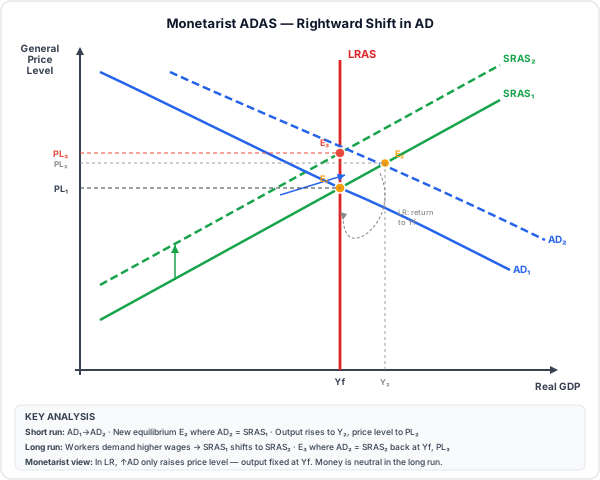
The transmission mechanism shows several channels through which monetary policy affects macroeconomic objectives. The interest rate channel operates via the intertemporal substitution effect: lower interest rates reduce the opportunity cost of borrowing, making investment and consumer loans more attractive. Businesses facing lower discount rates pursue previously unprofitable capital projects; households increase mortgage borrowing and consumption. This increases aggregate demand, shifting the AD curve rightward, stimulating output and employment. In a demand-deficient recession (as post-2008), this stimulus is valuable in preventing further contraction. The asset price channel is crucial for QE: large-scale asset purchases by the central bank reduce the supply of safe assets in the market, pushing up bond prices and equity prices (the "reach-for-yield" effect). Higher asset prices increase household wealth; the wealth effect (greater expected lifetime income) increases consumption. Higher equity prices make equity financing cheaper for firms, encouraging investment. For a central bank holding significant assets post-QE, portfolio rebalancing ensures these mechanisms propagate through the system. The credit channel emphasises that lower rates improve bank balance sheets (lower loan loss provisions) and reduce the cost of funding, enabling greater lending. The exchange rate channel shows that lower UK rates reduce the demand for sterling assets, depreciating sterling, which improves export competitiveness (though we must note this conflicts with import inflation).
However, critical limitations constrain monetary policy effectiveness. The liquidity trap occurs when interest rates approach zero and the money demand curve becomes horizontal—i.e., monetary expansion increases money supply, but with no offsetting fall in interest rates (they're already at the floor), aggregate demand fails to rise proportionally. This characterized the UK post-2009; despite low rates, lending growth remained weak until 2013 due to regulatory tightening and deleveraging. QE sidesteps the zero lower bound by directly stimulating demand and asset prices, but its effectiveness remains empirically contested. The Bank of England estimates QE raised UK GDP by 1.5-2%, avoiding deeper deflation and sustained depression, though counterfactual comparisons are inherently uncertain. Time lags represent another constraint: monetary policy operates with long and variable lags. Interest rate changes take 6-18 months to significantly affect aggregate demand, and policy decisions made in one economic cycle may only bind as conditions change, creating procyclical policy risk. Bluntness is a third limitation: interest rate cuts affect the entire economy uniformly; they cannot target specific sectors or regions experiencing different cyclical positions. The post-2008 UK saw persistent regional divergence—London and South-East thriving whilst Northern regions stagnated—yet monetary policy could not address this structural problem.
Assessing monetary policy's effectiveness against each objective reveals mixed outcomes. Price stability: The Bank achieved the 2% inflation target for much of 2010-2015 (inflation 1.5-2.5%), though post-referendum depreciation pushed inflation above target in 2017-2018. The CPI remained below pre-2008 levels, suggesting deflationary bias was successfully averted, a meaningful success given post-crisis deflation risks. However, the Bank's forward guidance, designed to anchor expectations, sometimes failed to credibly bind inflation expectations downward, creating expectation challenges. Full employment: Unemployment fell from 8.3% to 3.8%, a substantial improvement. However, quality issues emerged; zero-hours contracts proliferated, underemployment rose (part-time workers seeking full-time roles increased), and real wage growth remained negative until 2018. The Phillips Curve flattened—the traditional unemployment-inflation trade-off weakened—suggesting slack manifested in underemployment and lower wage inflation rather than headline joblessness. Growth: Real GDP growth averaged 1.8% annually, below pre-2008 trends (2.5-3%) and below comparable economies (Germany 1.6%, but US 2.3%). This sluggish recovery despite ultra-loose policy suggests monetary policy faced structural constraints—potential growth had fallen due to weak productivity, capital underinvestment, and labour force participation declines. Balance of payments: This objective received minimal attention; the current account deficit widened to 4-5% of GDP and remained unaddressed by monetary policy, reflecting the policy's focus on domestic demand rather than external rebalancing.
Beyond objectives, monetary policy generated significant side effects. The wealth inequality channel meant QE disproportionately benefited asset holders (the wealthy); house prices and equities inflated, whilst real wages for workers stagnated, exacerbating inequality (the Gini coefficient rose post-2008). Negative real interest rates (nominal rates below inflation) eroded savings returns, damaging savers and pensioners—a distributional concern inadequately considered. The financial stability channel emerged as a concern: extended low rates and QE inflated asset valuations, raising vulnerabilities in the financial system; policymakers increasingly focused on macroprudential regulation (loan-to-value caps, stress tests) rather than relying solely on monetary policy. Exchange rate effects: lower rates depreciated sterling post-2016, raising import inflation and real wage pressure—an unintended negative consequence. Finally, the "forward guidance" challenge: the Bank's repeated claims that rates would rise "sooner rather than later" failed to materialise, damaging credibility and anchoring expectations less effectively. In conclusion, monetary policy was partially effective: it prevented deflationary collapse, supported employment recovery, and maintained approximate price stability (notwithstanding recent inflation). However, it could not sustain rapid growth given structural constraints, addressed only one of four objectives adequately, and generated distributional costs. A balanced assessment recognises monetary policy as necessary but insufficient; it required complementary fiscal stimulus and supply-side reform to achieve fuller macroeconomic objectives. In the years post-2020, inflation re-emerged, forcing sharp rate rises, suggesting the prolonged zero-rate period may have generated longer-term imbalances (asset bubbles, excess savings, supply-side neglect) that ultimately undermined price stability—the primary objective.